Eye-to-Hand Calibration for Six-Axis Robots
This article describes how to perform eye-hand calibration for a six-axis Robot in an Eye-to-hand scenario.
1. Random Pose Sampling Calibration
1.1 Preparations Before Calibration
Before eye-hand calibration, complete the following preparations:
(1) Complete the hardware setup of the 3D Vision Guidance Kit
Please refer to 3D Vision Guidance Kit Hardware Setup to complete the installation and connection of the Robot, Camera, and industrial PC
(2) Create a Project and a task
Please refer to Project Operation Guide and Task Operation Guide to create a Project and a task.
(3) Complete Camera connection and parameter adjustment, and configure it in the task information
Please refer to Camera Connection and Parameter Adjustment Guide to connect the Camera, perform camera imaging quality adjustment, verify Camera accuracy, and configure it in the task information.
(4) Complete Robot communication configuration
Please refer to Robot Configuration and Communication Operation Guide to establish communication between the Robot and PickWiz.
(5) Prepare the materials required for calibration
Please ensure that the Calibration Board is flat and clear, with no obvious scratches or dirt, and without bending or deformation
If the calibration method is random pose sampling calibration, please ensure that the Calibration Board is placed on the work platform and is within the Camera field of view.
1.2 Calibration Information Configuration
Enter the eye-hand calibration interface, click Add Eye-Hand Calibration, and enter the calibration information configuration interface.
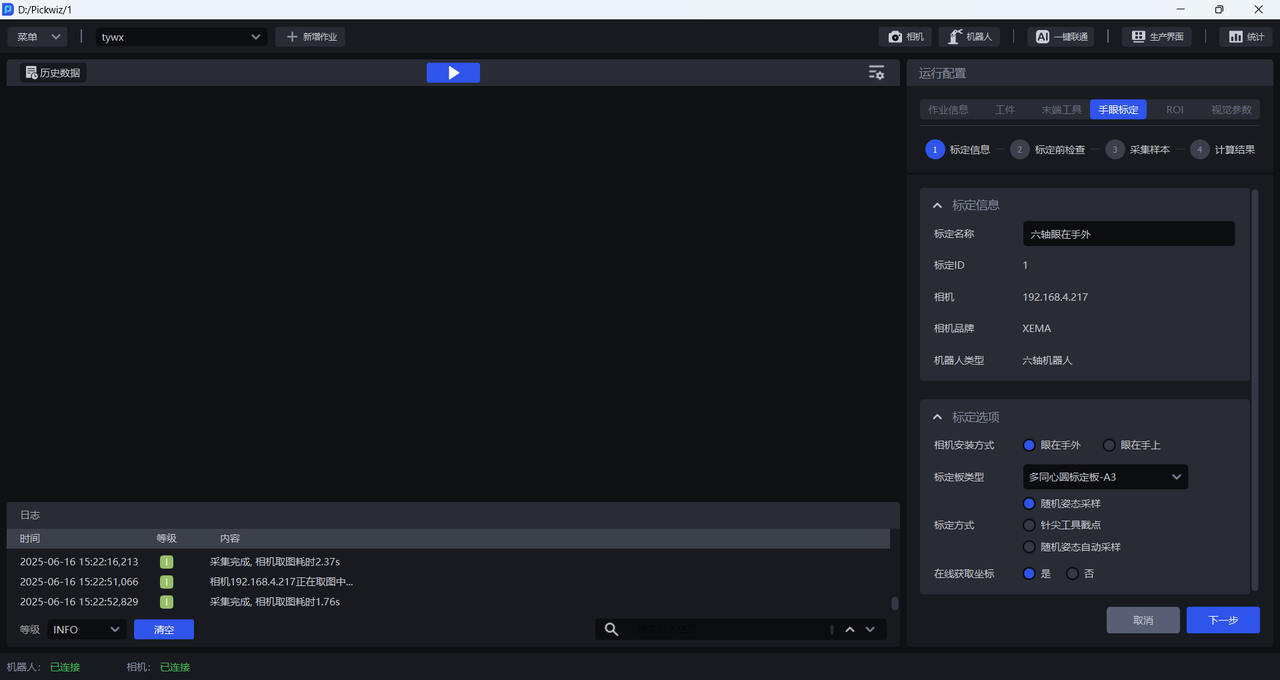
Calibration Namecan be used to name the current calibration configurationCalibration IDis used by the Robot to switch calibration configurationsCamerais the IP address of the currently connected CameraCamera Brandis the brand of the currently connected CameraRobot Typemust be consistent with the Robot type in Robot ConfigurationFor
Camera Installation Method, selectEye-to-HandFor
Calibration Board Type, select the current Calibration Board type
A suitable Calibration Board is mainly determined by the Robot type and the Camera mounting height. Please select an appropriate Calibration Board according to the actual scenario requirements and with reference to the table below.
| Robot Type | Camera Mounting Height | Select Calibration Board |
|---|---|---|
| Six-axis Robot | Below 0.5 m | A6 Multi-Concentric-Circle Calibration Board |
| Below 1.5 m | A5 Multi-Concentric-Circle Calibration Board | |
| 1.5 m -- 2.5 m | A4 Multi-Concentric-Circle Calibration Board | |
| Above 2.5 m | A3 Multi-Concentric-Circle Calibration Board | |
| Three-axis/Four-axis Robot | Below 0.5 m | A6 Multi-Concentric-Circle Calibration Board |
| Below 1.5 m | A5 Multi-Concentric-Circle Calibration Board | |
| 1.5 m -- 2.5 m | A4 Multi-Concentric-Circle Calibration Board | |
| Above 2.5 m | A3 Multi-Concentric-Circle Calibration Board |
For
Calibration Method, selectRandom Pose Sampling CalibrationIf the Robot has the corresponding calibration program written, and the Robot needs to run the calibration program to send the pose to PickWiz when sampling the Calibration Board, then
Get Coordinates Online** selectYes; if the Robot does not have the corresponding calibration program written, and you need to manually enter the pose of the Robot Tool when sampling the Calibration Board, thenGet Coordinates Online**selectNo.
1.3 Checks Before Calibration
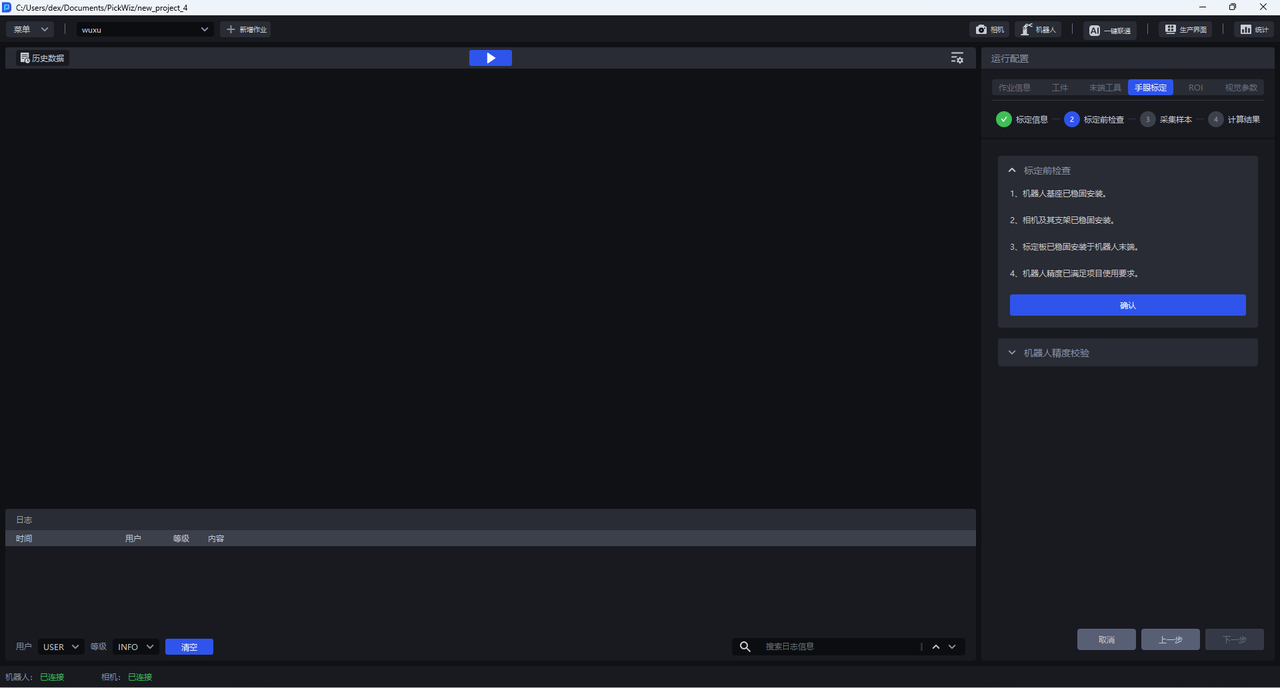
- Ensure that the Robot base is securely installed
Before performing eye-hand calibration, carefully inspect the installation of the Robot base. If the Robot base is not securely installed, obvious shaking will occur when the Robot moves, affecting Robot accuracy and thereby affecting the calibration results.
Check whether the installation of the Robot base meets the requirements by following these steps:
First, the plane on which the Robot base is installed must be flat and kept clean;
Second, operate the Robot to perform large-amplitude translation or rotation at 100% speed, and observe whether there are signs of shaking. If there is shaking, readjust and secure the Robot base to ensure that no displacement or tilting occurs when the Robot moves;
Third, check whether the Robot body and the base are tightly connected, and tighten the screws to prevent loosening.
- Ensure that the Camera and its bracket are securely installed
Before performing eye-hand calibration, carefully inspect the installation of the Camera and its bracket. If the Camera and its bracket are not securely installed, the camera imaging quality will be affected, thereby affecting the calibration results.
Check whether the installation of the Camera and its bracket meets the requirements by following these steps:
First, check whether the Camera bracket is a machined part, and the material of the bracket should avoid aluminum profiles;
Second, shake the bracket and observe whether there is obvious shaking. If there is shaking, readjust and secure the bracket;
Third, shake the Camera and observe whether there is obvious shaking to ensure that the Camera is securely installed.
- Ensure that the Calibration Board is stably positioned within the Camera field of view
For the Eye to hand Camera mounting method, the Calibration Board must be mounted on the Tool to ensure that the Calibration Board is within the Camera field of view.
- Ensure that Robot accuracy meets the Project usage requirements
If Robot accuracy does not meet the Project usage requirements, please refer to Calibration Verification to correct Robot accuracy.
1.4 Collect Samples
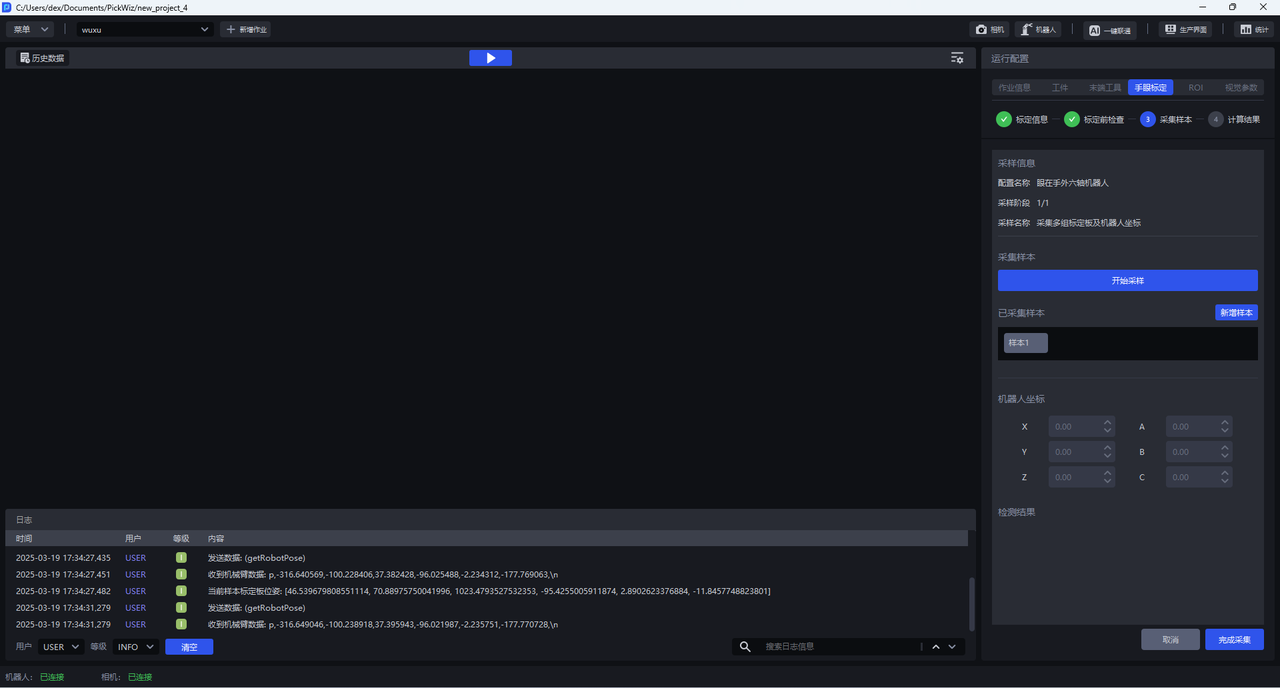
1.4.1 Collect Multiple Sets of Calibration Board and Robot Coordinates
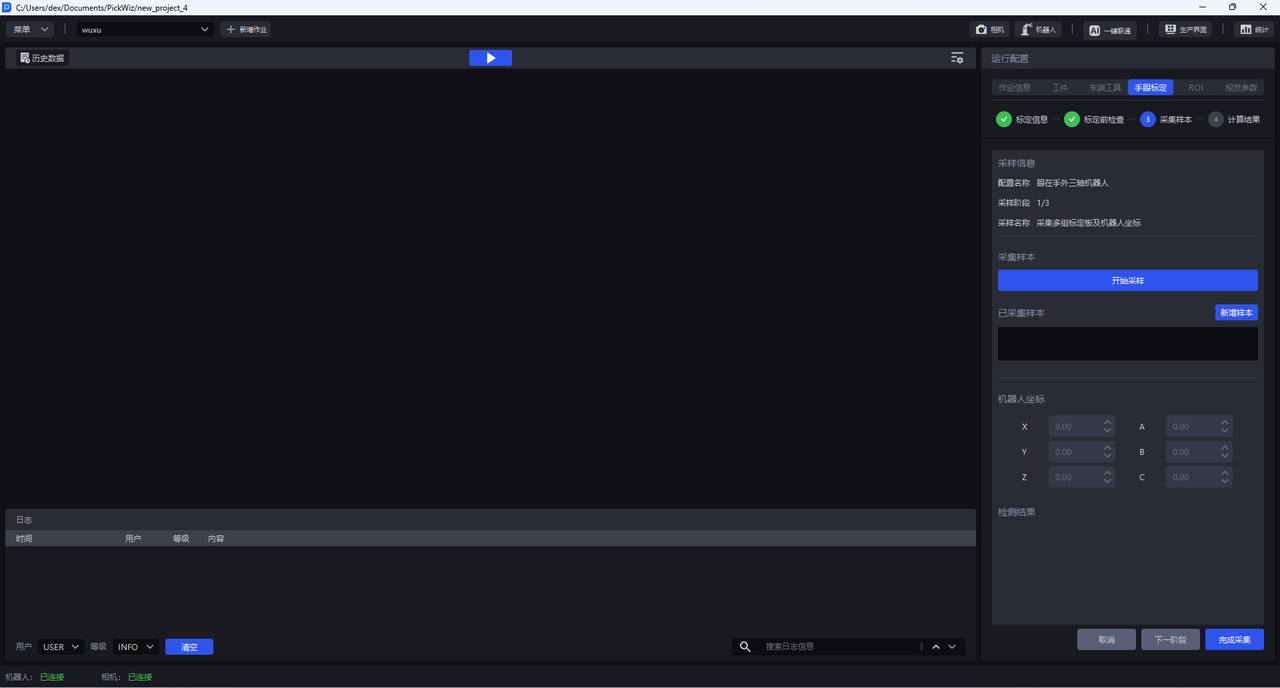
(1) Control the Robot to move while carrying the Calibration Board so that the Calibration Board is at the center of the Camera field of view and parallel to the Camera imaging plane.
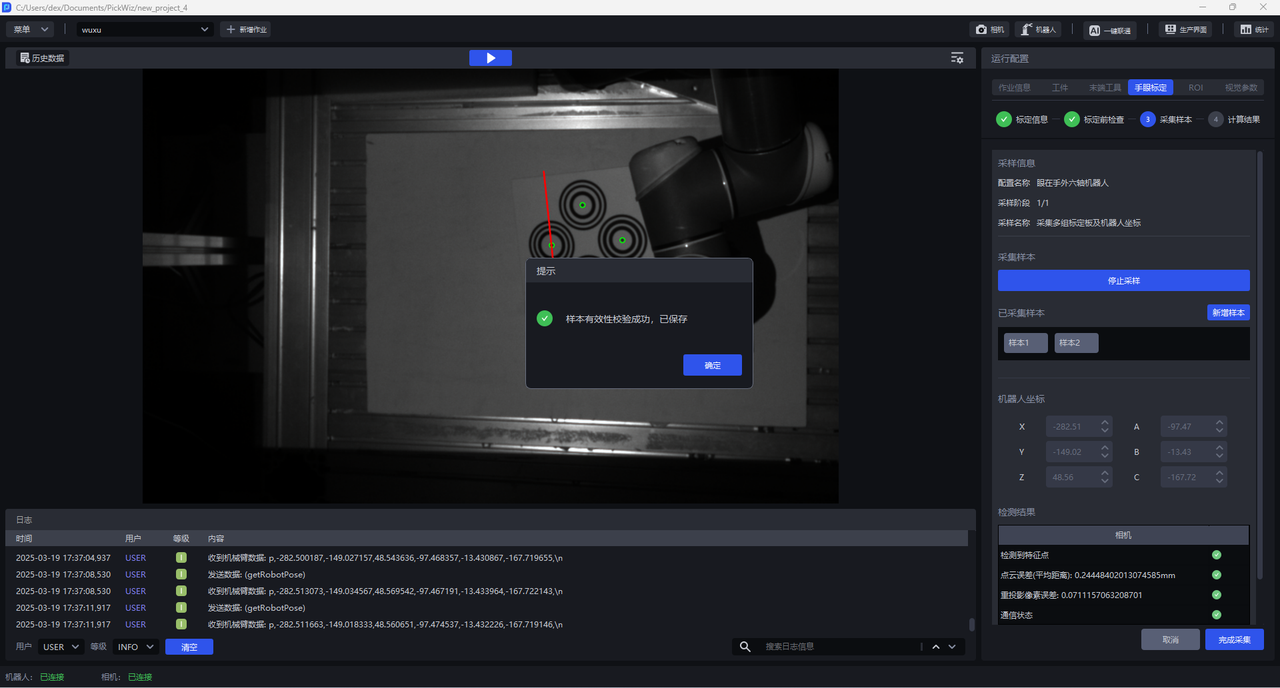
(2) Click Start Sampling. The Start Sampling button changes to Stop Sampling, and the Detection Results Panel below shows two types of checks: Camera and Robot. If both checks are green icons, the checks pass. If there is a red icon, the check failed and should be inspected.
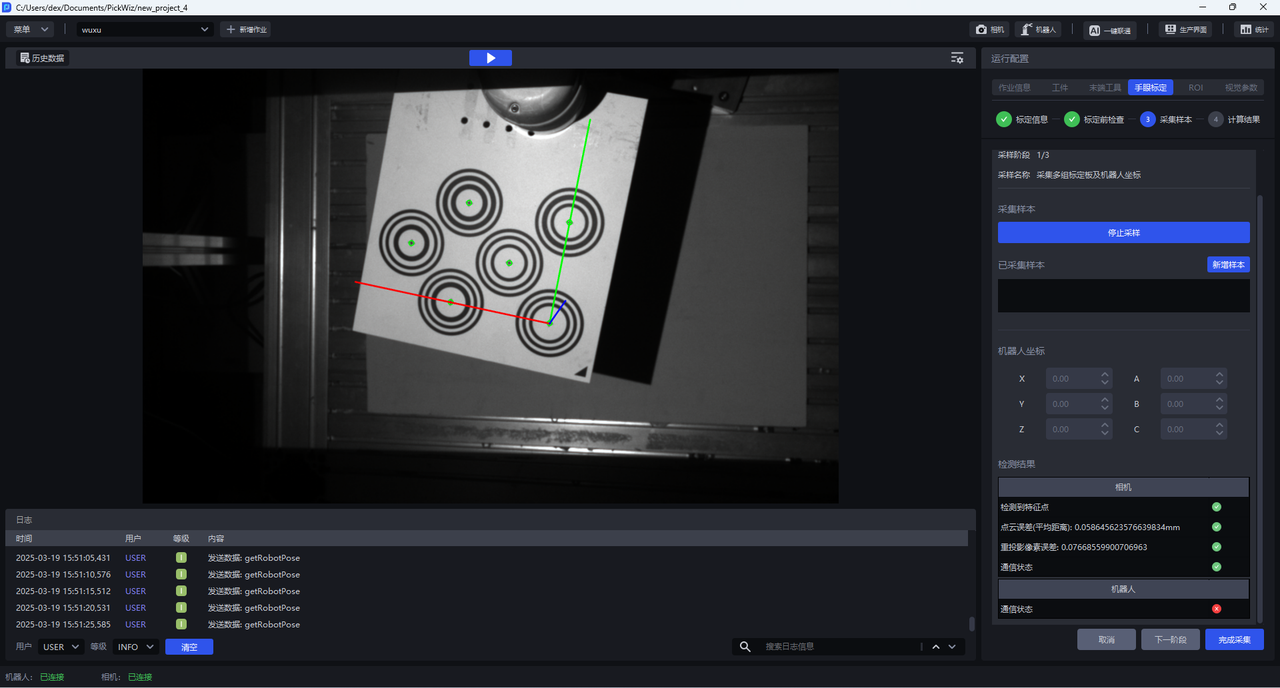
(3) Camera checks are divided into 4 aspects:
(4) Robot checks are divided into 3 aspects:
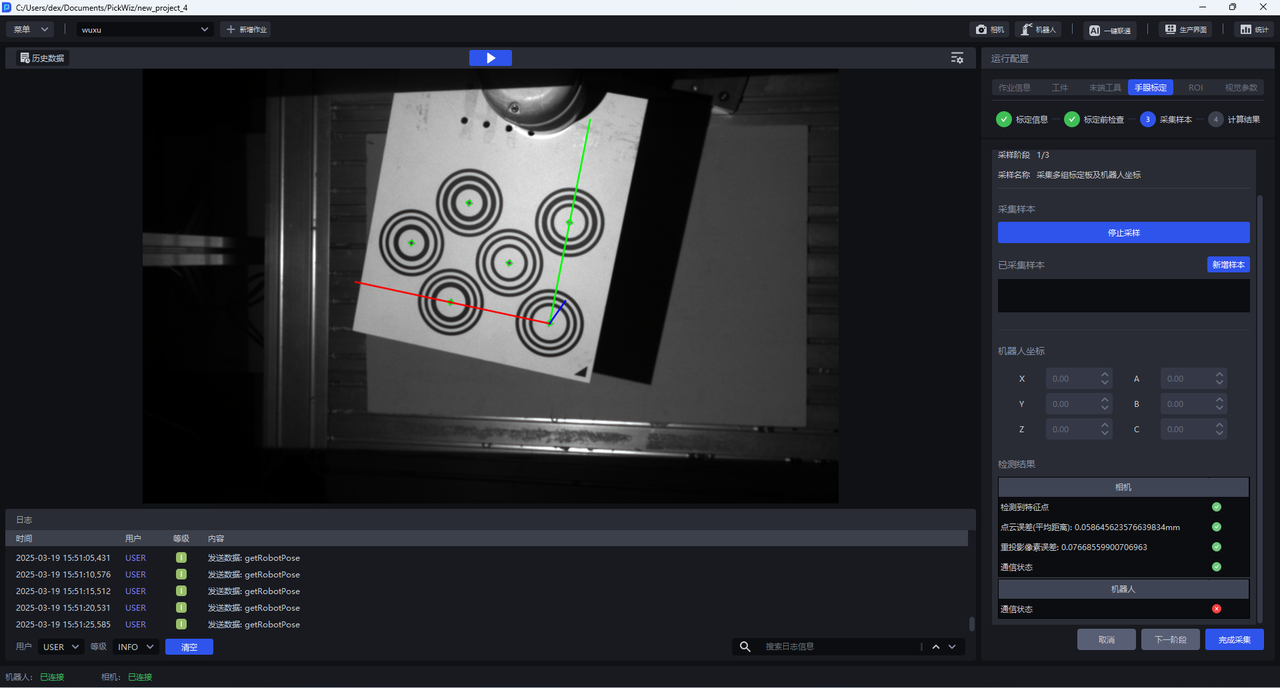
(5) Coordinate axes appear on the Calibration Board in the visualization window, and the center of each concentric circle is green, indicating that the current pose meets the requirements.
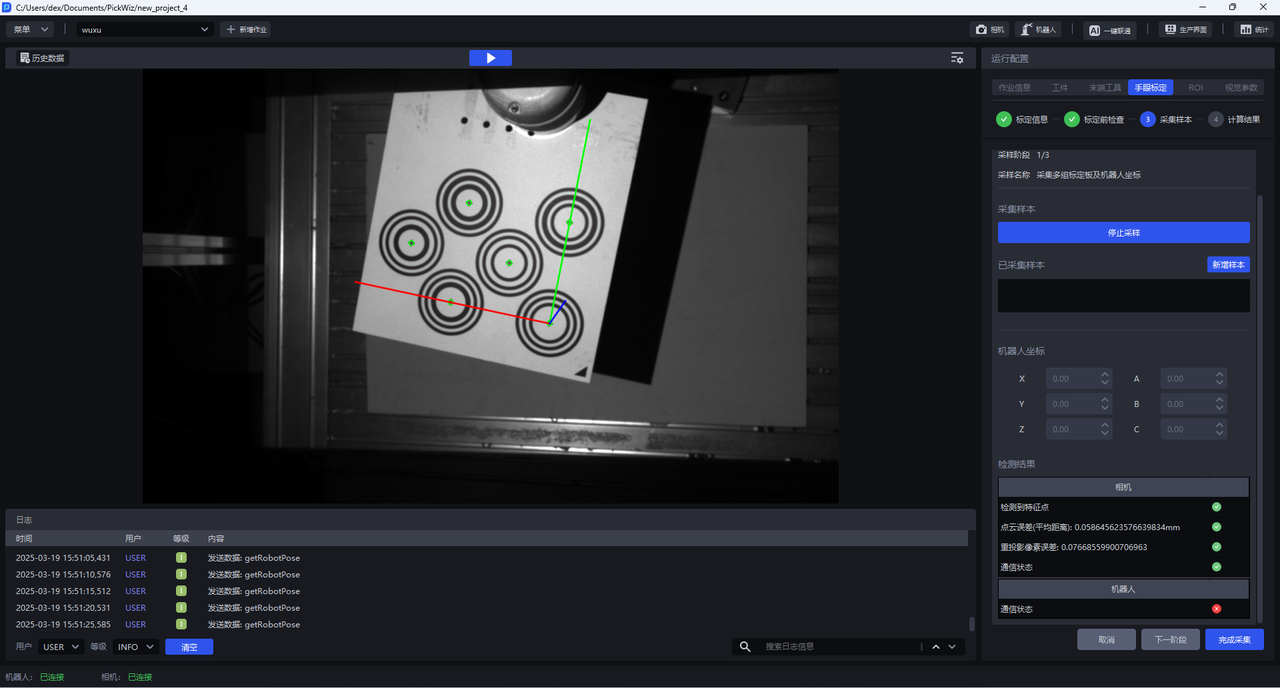
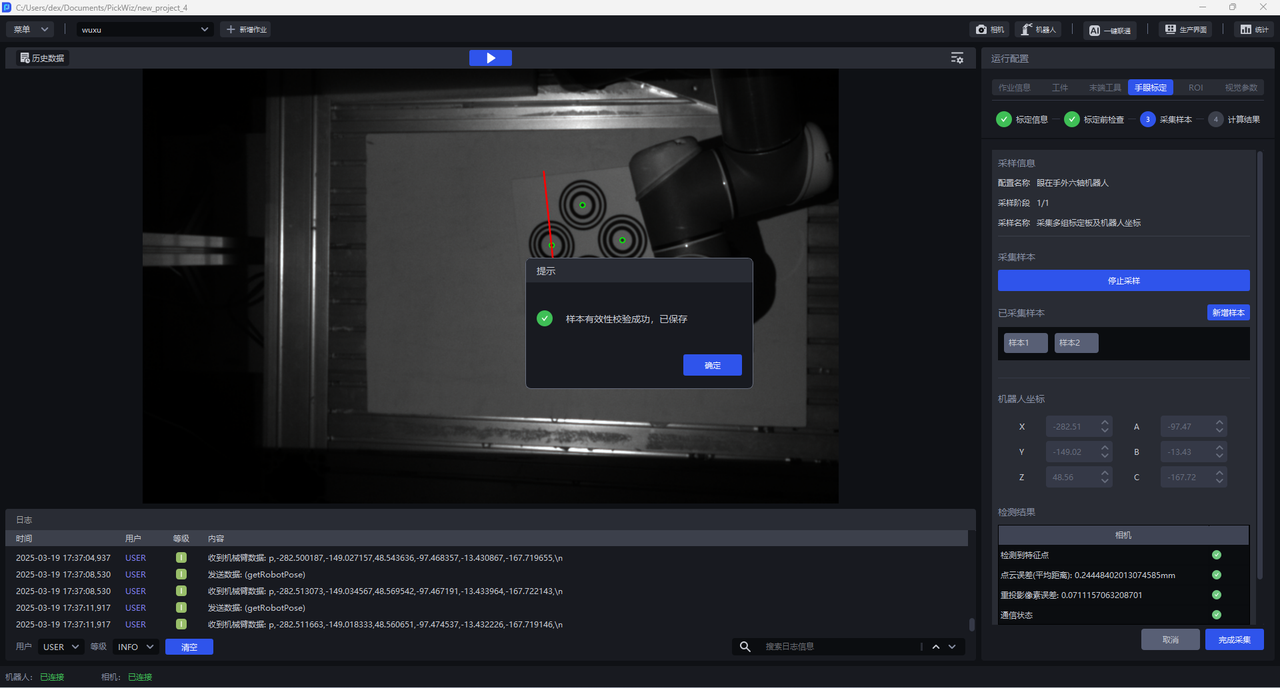
(6) Click Add Sample. If the sample is valid, a Sample Validity Check Passed popup appears. After clicking OK, Collected Samples shows the Sample 1 marker. Click Sample 1 to view the saved sample, and click the close button after Sample 1 to delete the sample.
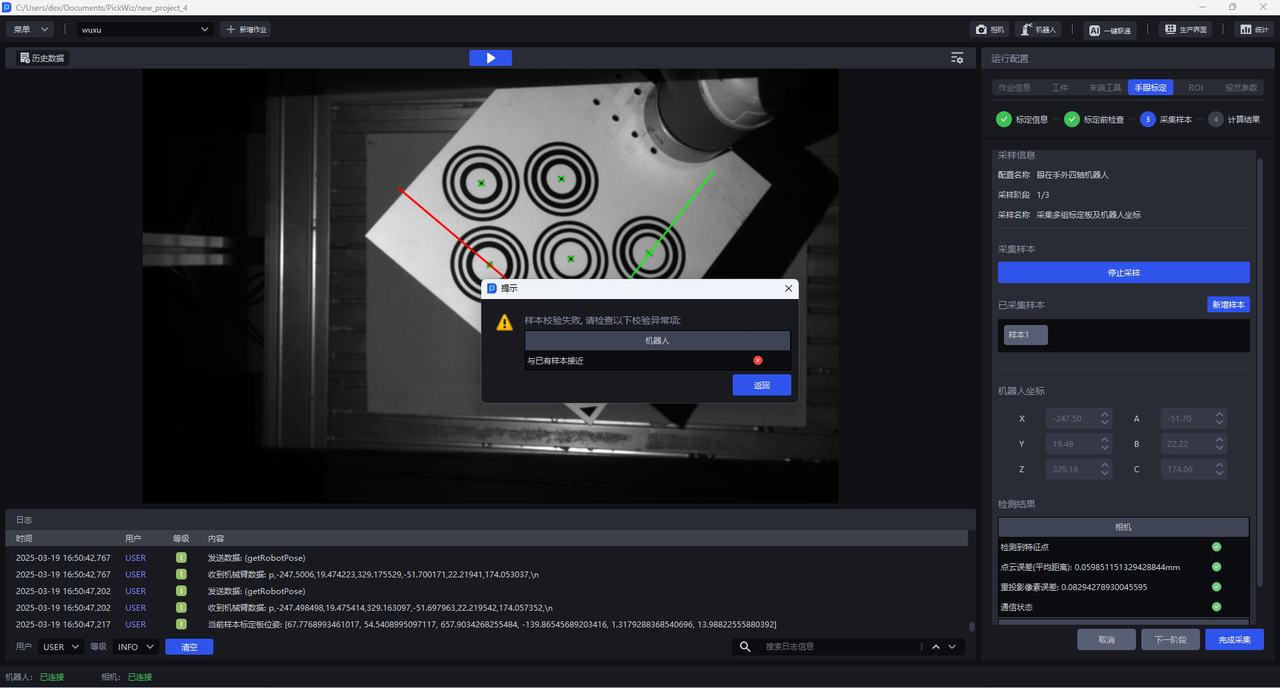
If the sample is close to an existing sample, the sample is invalid, and a Sample Validation Failed popup appears with the message Close to Existing Samples. After clicking Back, control the Robot carrying the Calibration Board to move and collect the sample again.
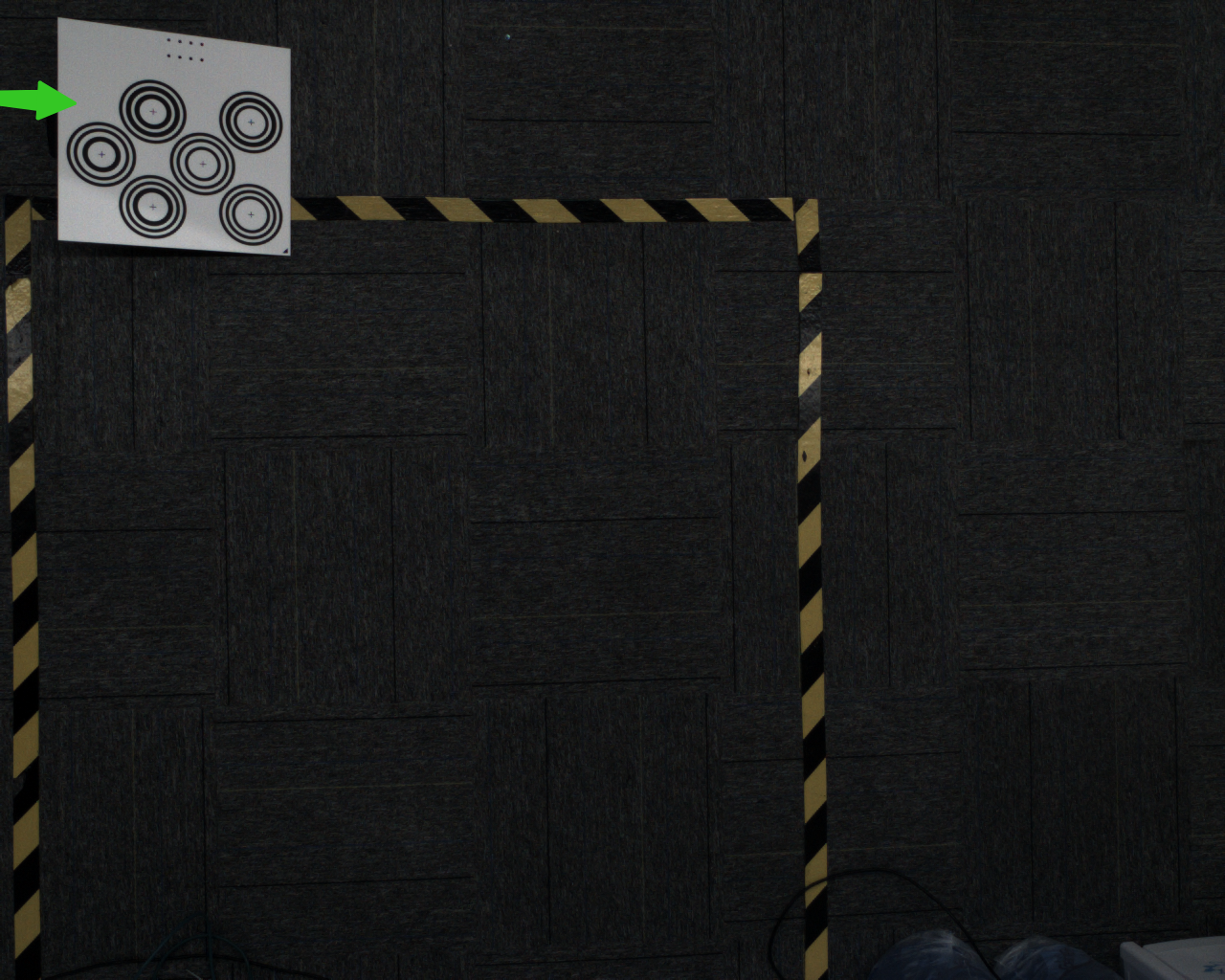
(7) Control the Robot to move while carrying the Calibration Board so that the Calibration Board is located at the four corners of the Camera field of view, and the rotation angles on the X, Y, and Z axes are all greater than 10°. Repeat the above sample collection steps until at least 10 samples are saved.
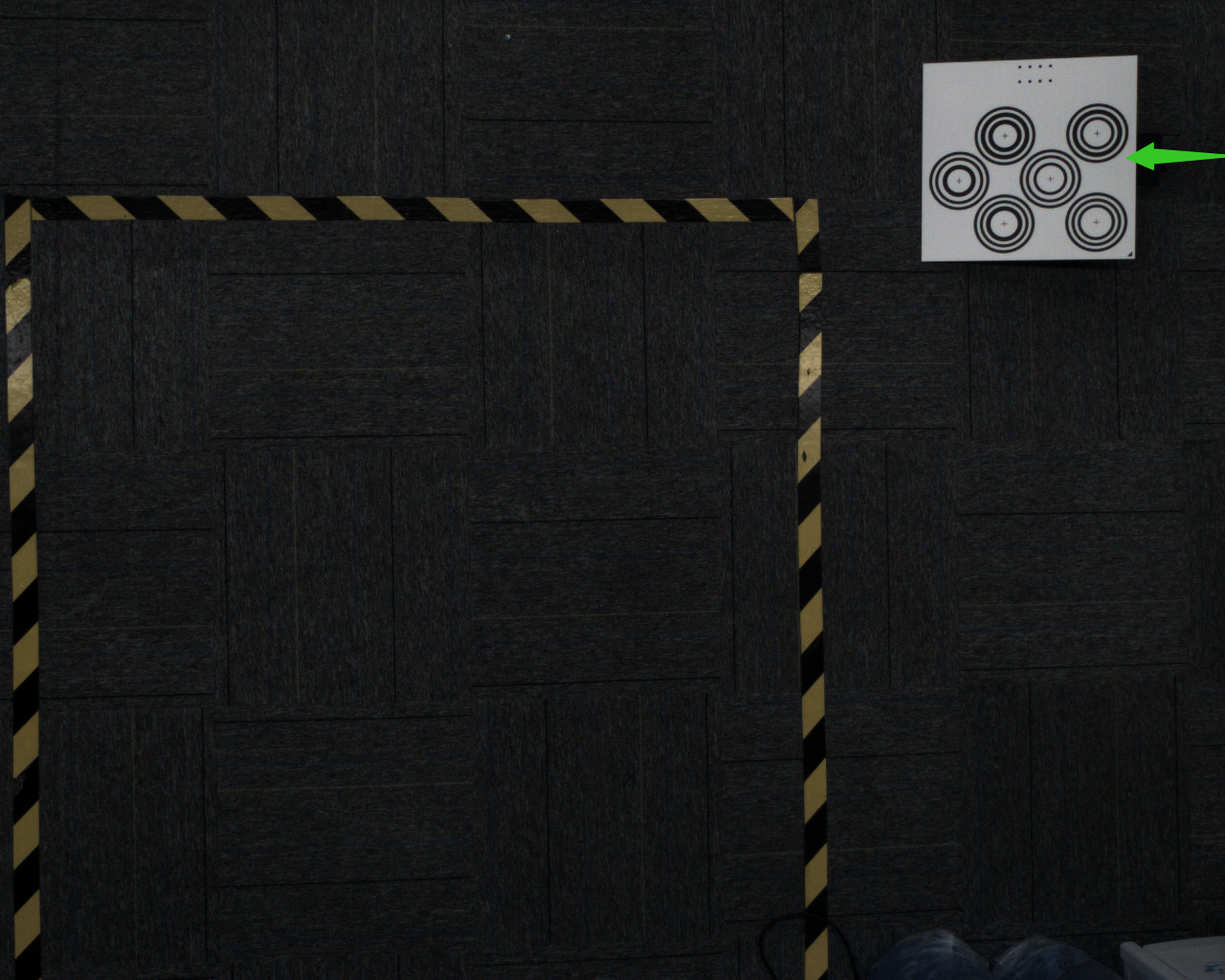
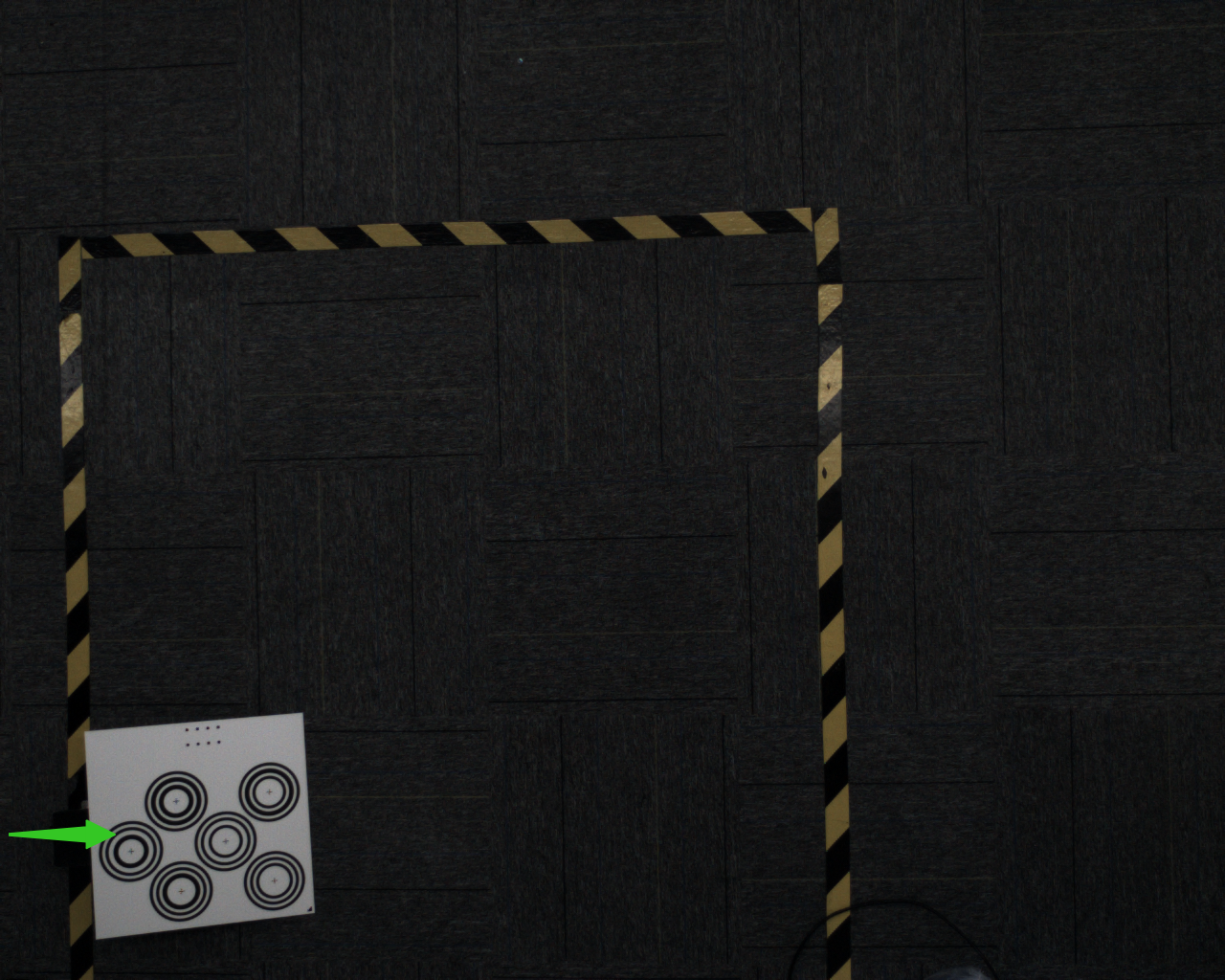
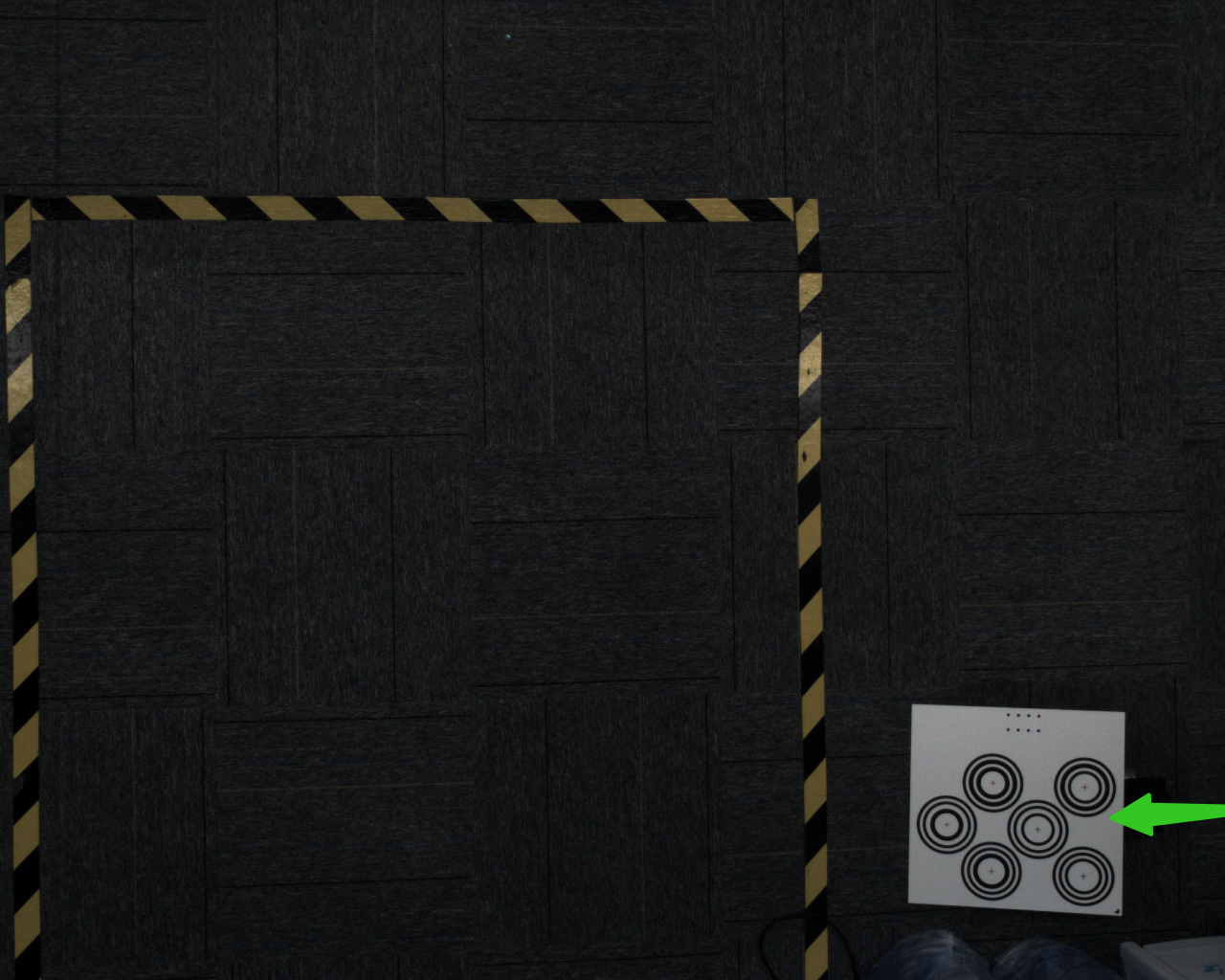
(8) After saving at least 10 valid samples, click Finish Collection to enter the Calculation Results interface.
1.4.2 Calculate Calibration Results
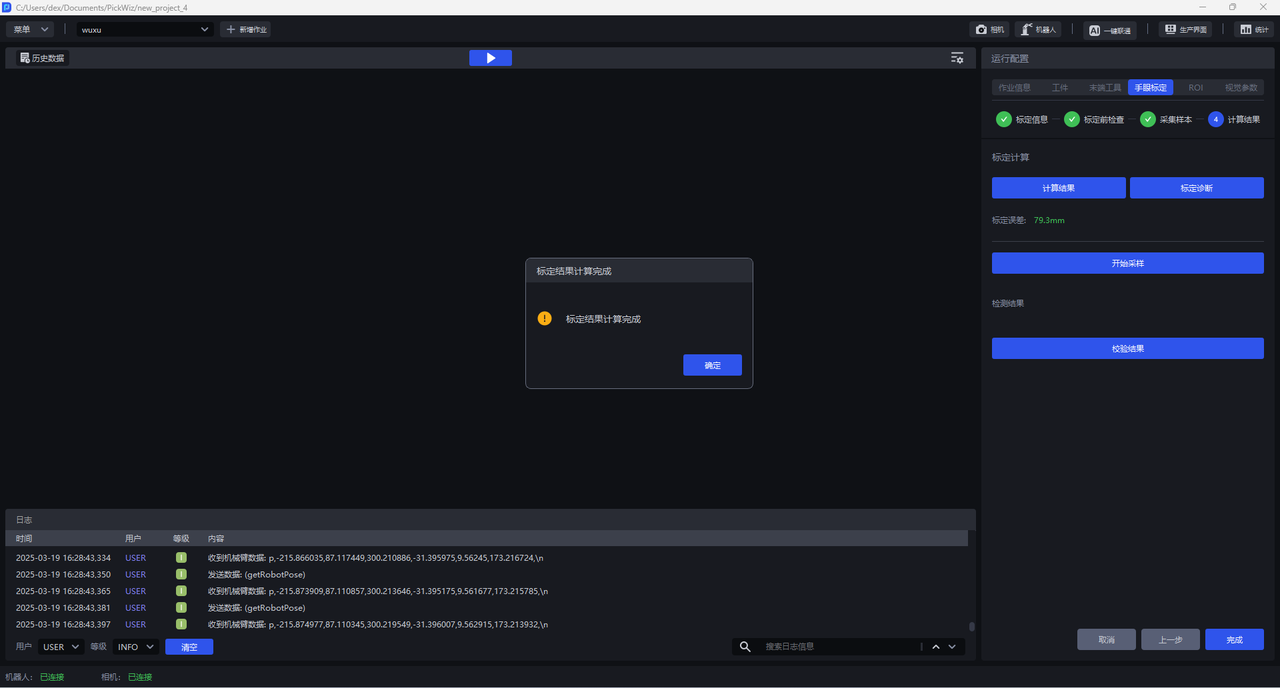
Click Calculation Results. PickWiz calculates the calibration results based on the collected samples. If the accuracy of the calibration results does not meet the requirements, perform Calibration Result Inspection and Analysis.
1.5 Calibration Result Inspection and Analysis
If Calibration Error exceeds the normal range, the cause of the error must be identified. Click Calibration Diagnosis, and refer to Calibration Result Inspection and Analysis to analyze the calibration results, resolve the issue, and check again until the calibration accuracy meets the scenario requirements.
1.6 Select the Eye-Hand Calibration Configuration
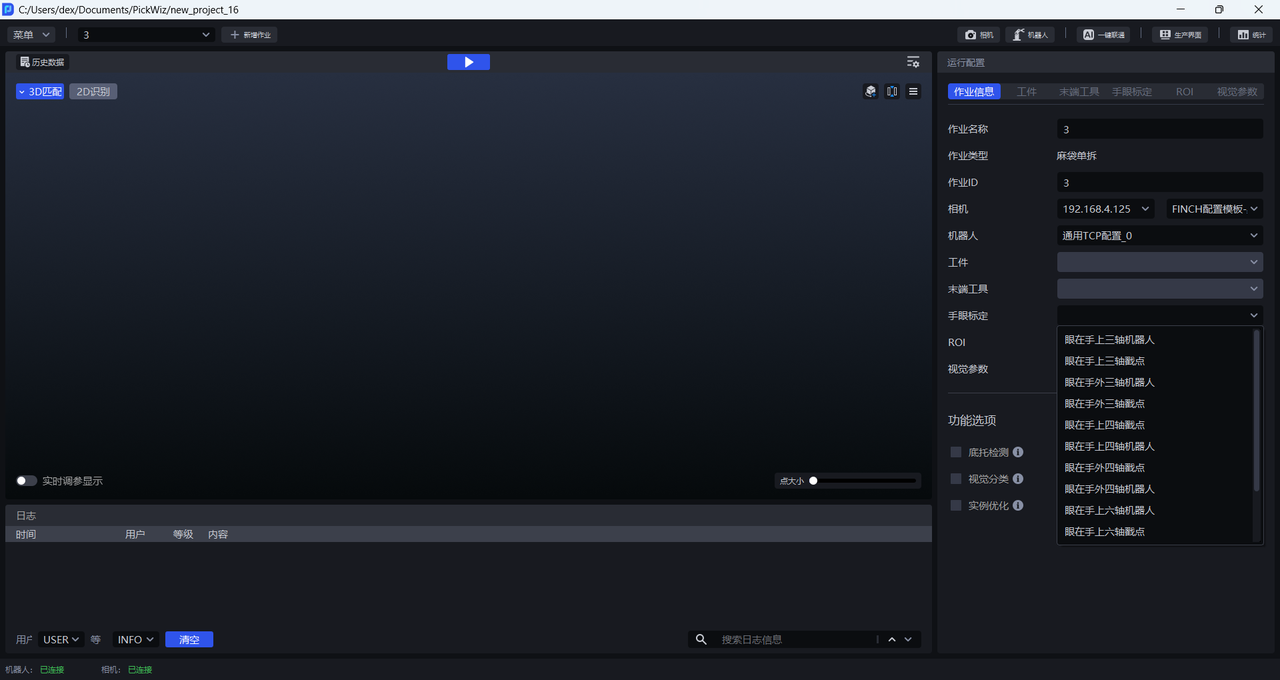
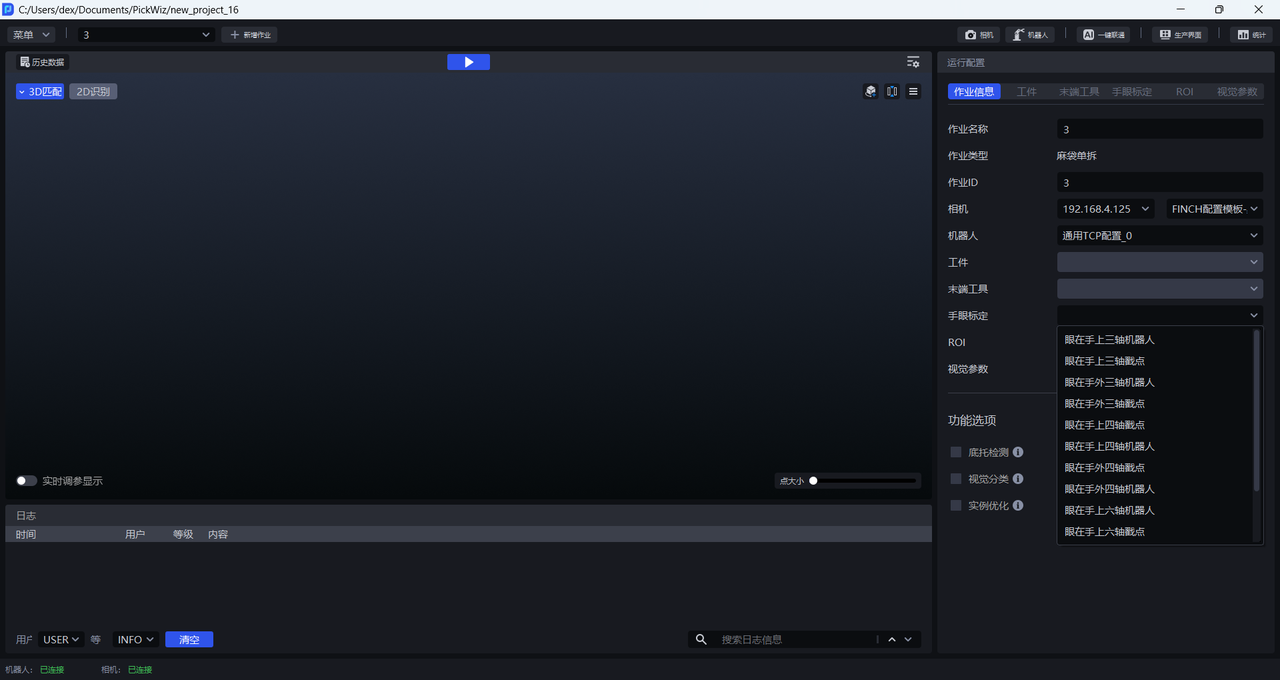
After the calibration process is complete, return to the Run Configuration interface, click Job Information, click the dropdown list for Eye-Hand Calibration, and select the corresponding eye-hand calibration configuration.
2. Pin Tool Contact-Point Calibration
2.1 Preparation Before Calibration
Before eye-hand calibration, complete the following preparations:
(1) Complete the hardware setup of the 3D Vision Guidance Kit
Please refer to 3D Vision Guidance Kit Hardware Setup to complete the installation and connection of the Robot, Camera, and industrial PC
(2) Create a Project and a task
Please refer to Project Operation Guide and Task Operation Guide to create a Project and a task.
(3) Complete Camera connection and parameter adjustment, and configure it in the task information
Please refer to Camera Connection and Parameter Adjustment Guide to connect the Camera, perform camera imaging quality adjustment, verify Camera accuracy, and configure it in the task information.
(4) Complete Robot communication configuration
Please refer to Robot Configuration and Communication Operation Guide to establish communication between the Robot and PickWiz.
(5) Prepare the materials required for calibration
Please ensure that the Calibration Board is flat and clear, with no obvious scratches or dirt, and without bending or deformation
If the calibration method is random pose sampling calibration, please ensure that the Calibration Board is placed on the work platform and is within the Camera field of view.
2.2 Calibration Information Configuration
Enter the eye-hand calibration interface, click Add Eye-Hand Calibration, and enter the calibration information configuration interface.
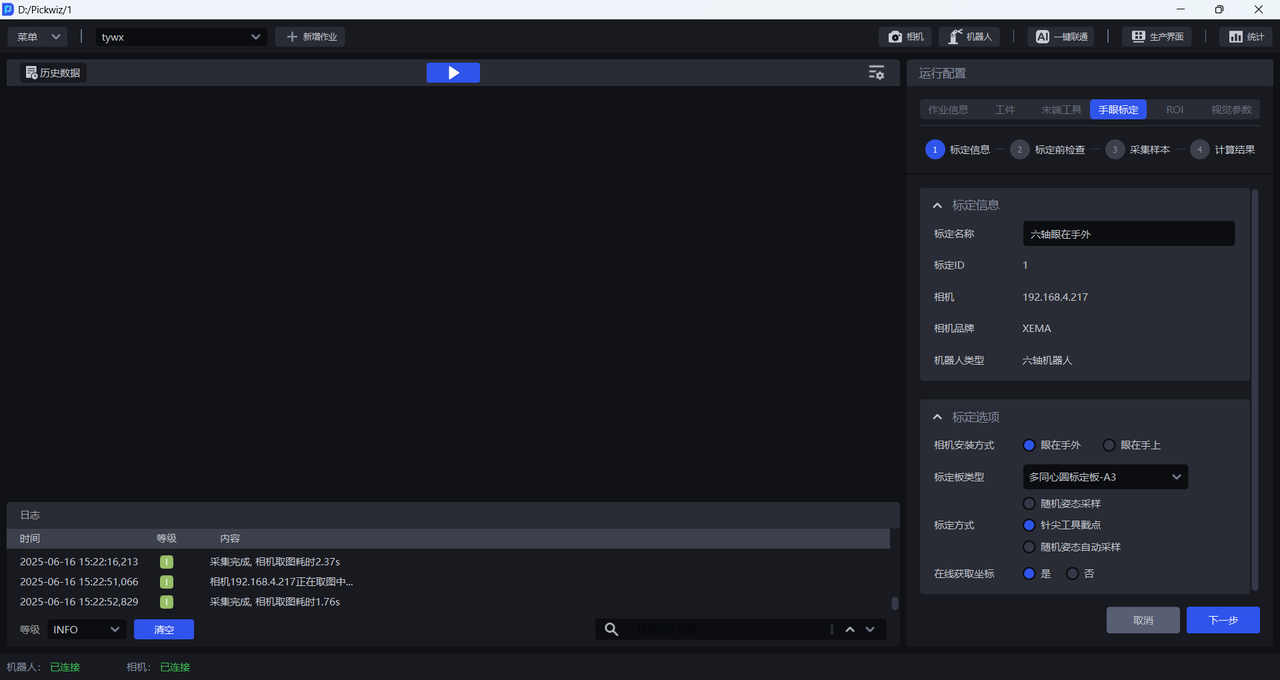
Calibration Namecan be used to name the current calibration configurationCalibration IDis used by the Robot to switch calibration configurationsCamerais the IP address of the currently connected CameraCamera Brandis the brand of the currently connected CameraRobot Typemust be consistent with the Robot type in Robot ConfigurationFor
Camera Installation Method, selectEye-to-HandFor
Calibration Board Type, select the current Calibration Board type
A suitable Calibration Board is mainly determined by the Robot type and the Camera mounting height. Please select an appropriate Calibration Board according to the actual scenario requirements and with reference to the table below.
| Robot Type | Camera Mounting Height | Select Calibration Board |
|---|---|---|
| Six-axis Robot | Below 0.5 m | A6 Multi-Concentric-Circle Calibration Board |
| Below 1.5 m | A5 Multi-Concentric-Circle Calibration Board | |
| 1.5 m -- 2.5 m | A4 Multi-Concentric-Circle Calibration Board | |
| Above 2.5 m | A3 Multi-Concentric-Circle Calibration Board | |
| Three-axis/Four-axis Robot | Below 0.5 m | A6 Multi-Concentric-Circle Calibration Board |
| Below 1.5 m | A5 Multi-Concentric-Circle Calibration Board | |
| 1.5 m -- 2.5 m | A4 Multi-Concentric-Circle Calibration Board | |
| Above 2.5 m | A3 Multi-Concentric-Circle Calibration Board |
For
Calibration Method, selectPin-Tip Touch CalibrationIf the Robot has the corresponding calibration program written, and the Robot needs to run the calibration program to send the pose to PickWiz when sampling the Calibration Board, then
Get Coordinates Online** selectYes; if the Robot does not have the corresponding calibration program written, and you need to manually enter the pose of the Robot Tool when sampling the Calibration Board, thenGet Coordinates Online**selectNo.
2.3 Checks Before Calibration
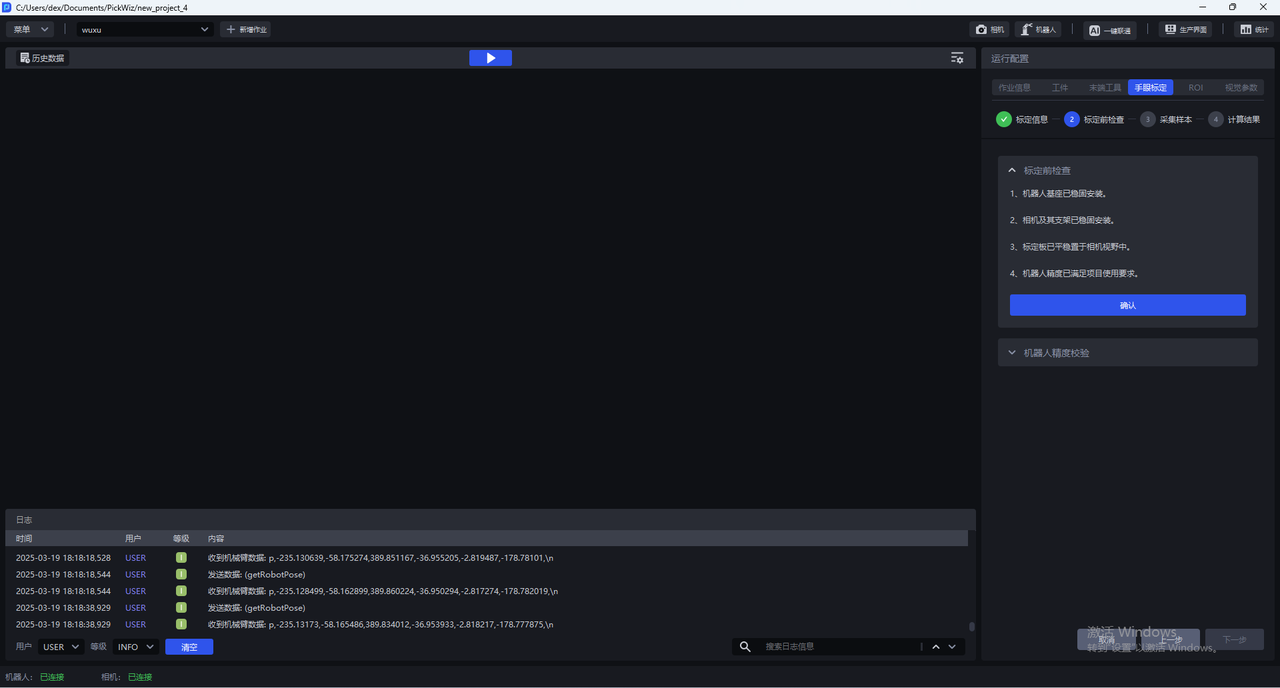
- Ensure that the Robot base is securely installed
Before performing eye-hand calibration, carefully inspect the installation of the Robot base. If the Robot base is not securely installed, obvious shaking will occur when the Robot moves, affecting Robot accuracy and thereby affecting the calibration results.
Check whether the installation of the Robot base meets the requirements by following these steps:
First, the plane on which the Robot base is installed must be flat and kept clean;
Second, operate the Robot to perform large-amplitude translation or rotation at 100% speed, and observe whether there are signs of shaking. If there is shaking, readjust and secure the Robot base to ensure that no displacement or tilting occurs when the Robot moves;
Third, check whether the Robot body and the base are tightly connected, and tighten the screws to prevent loosening.
- Ensure that the Camera and its bracket are securely installed
Before performing eye-hand calibration, carefully inspect the installation of the Camera and its bracket. If the Camera and its bracket are not securely installed, the camera imaging quality will be affected, thereby affecting the calibration results.
Check whether the installation of the Camera and its bracket meets the requirements by following these steps:
First, check whether the Camera bracket is a machined part, and the material of the bracket should avoid aluminum profiles;
Second, shake the bracket and observe whether there is obvious shaking. If there is shaking, readjust and secure the bracket;
Third, shake the Camera and observe whether there is obvious shaking to ensure that the Camera is securely installed.
- Ensure that the Calibration Board is stably positioned within the Camera field of view
For the Eye to hand Camera mounting method, please place the Calibration Board on the work platform to ensure that the Calibration Board is within the Camera field of view.
- Ensure that Robot accuracy meets the Project usage requirements
If Robot accuracy does not meet the Project usage requirements, please refer to Calibration Verification to correct Robot accuracy.
2.4 Collect Samples
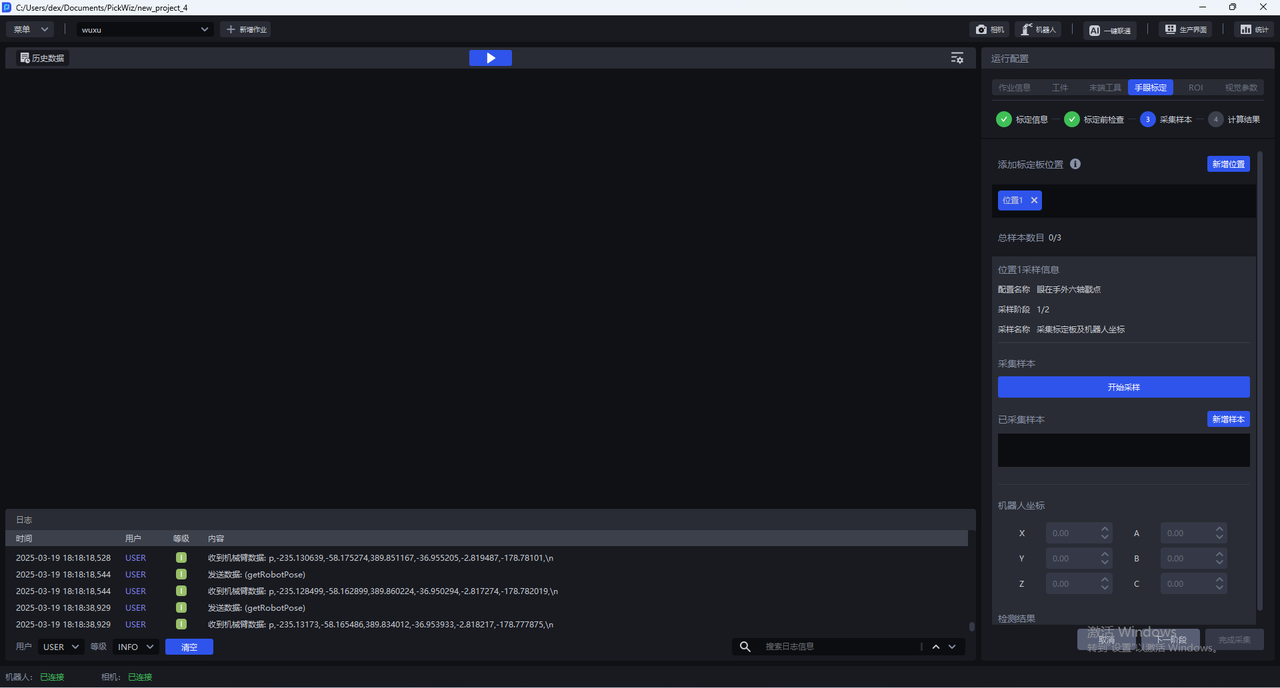
2.4.1 Collect Calibration Board and Robot Coordinates
(1) Adjust the position of the Calibration Board, place it within the target object placement area, and click Start Sampling.
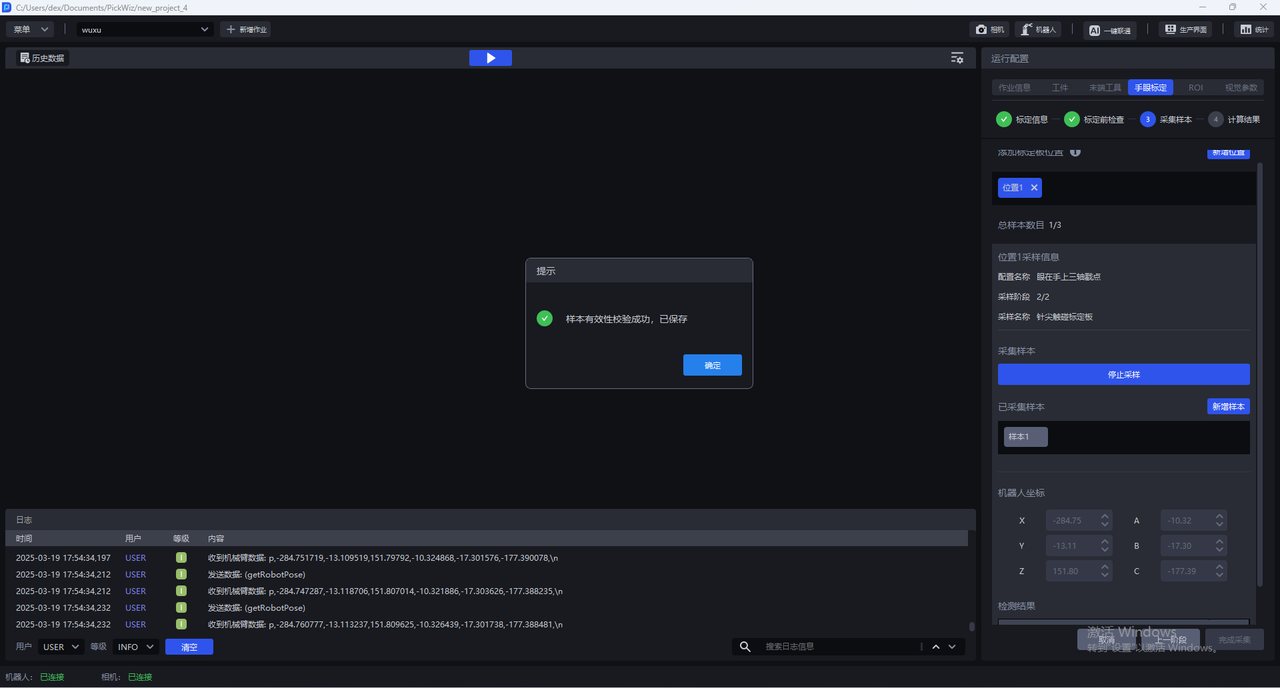
(2) Click Add Sample. If the sample is valid, Saved Successfully appears; if the sample is close to an existing sample, the sample is invalid and a save failure message appears.
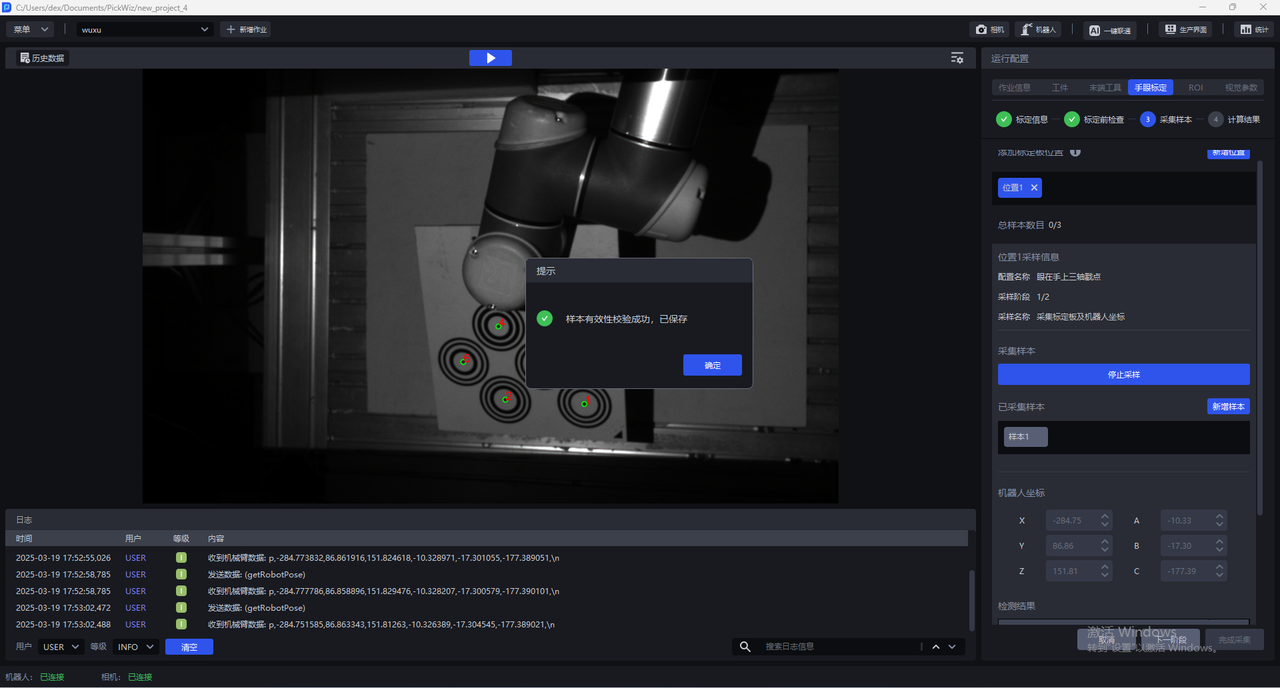
(3) Check the detection results. If each detection item is a green icon, coordinate axes and feature points appear in the visualization window, and all circle centers are green, the current pose meets the requirements.
Detection is divided into 4 aspects:
2.4.2 Touch the Calibration Board with the Pin Tip
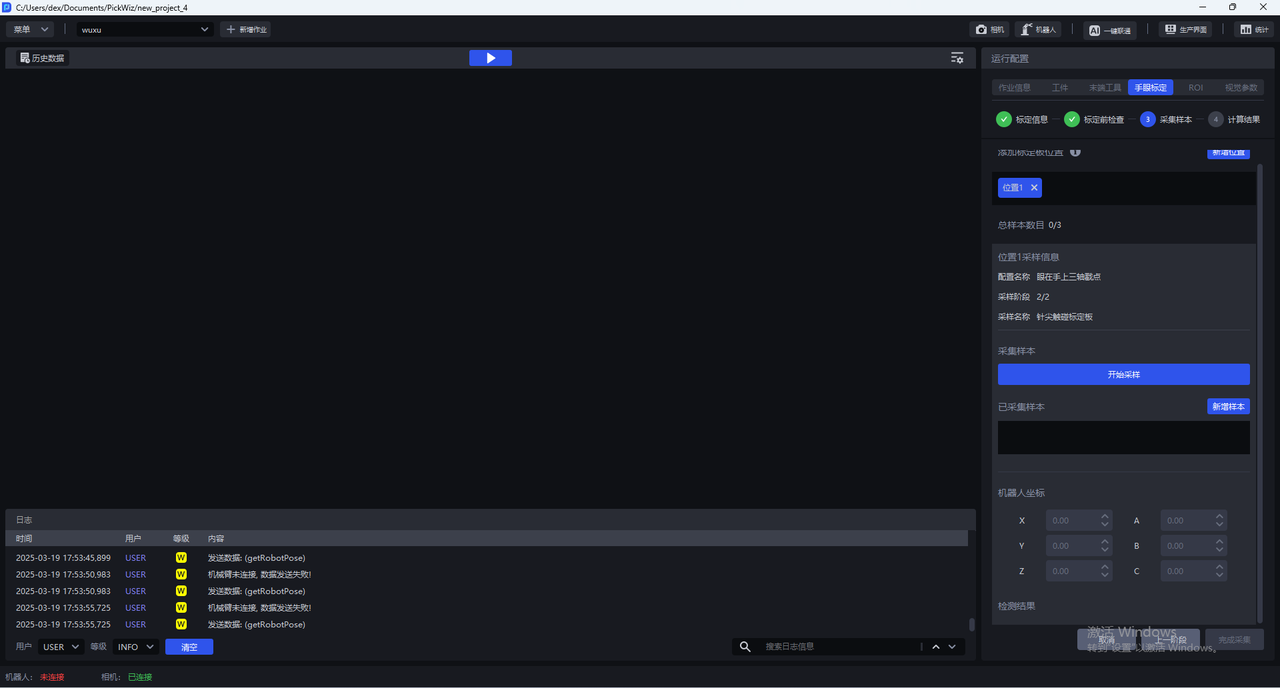
(1) Click Start Sampling, control the Robot to move, and have the needle tip touch the center of each corresponding concentric circle in the numerical order marked in the visualization window.
(2) Click Add Sample to collect the Robot coordinates during contact-point sampling.
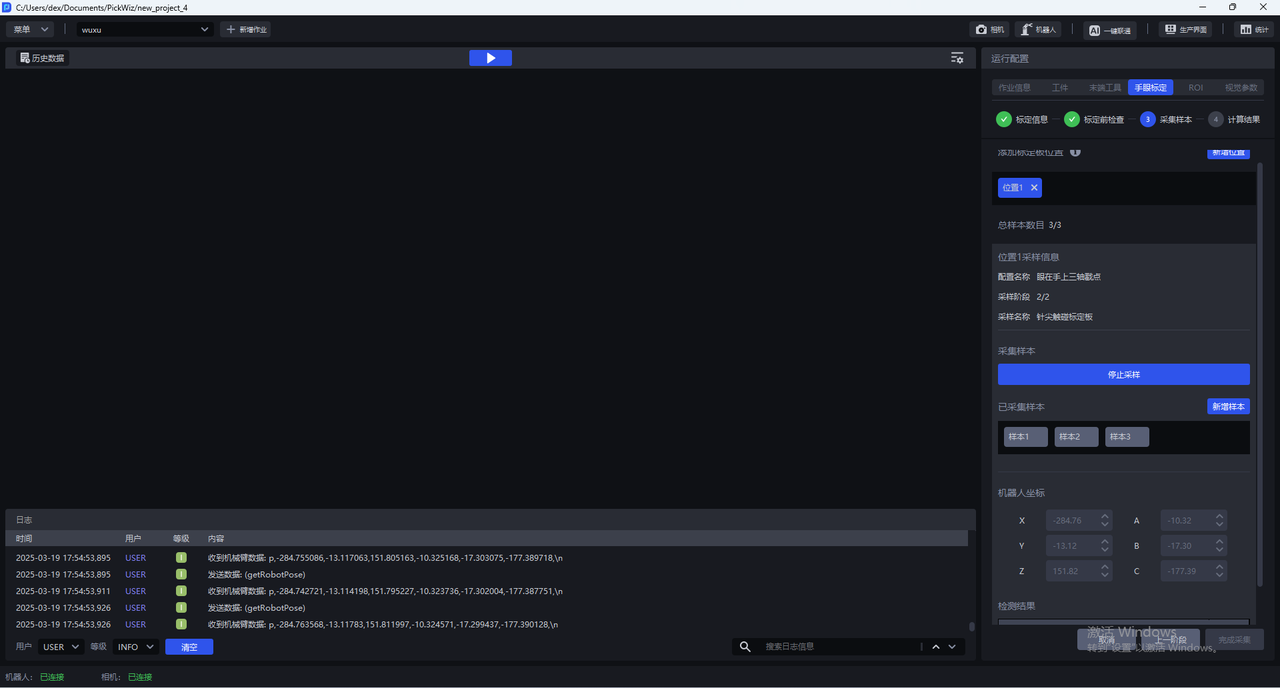
(3) Repeat the above steps to collect at least 3~6 concentric-circle contact-point samples.
- Click
Next
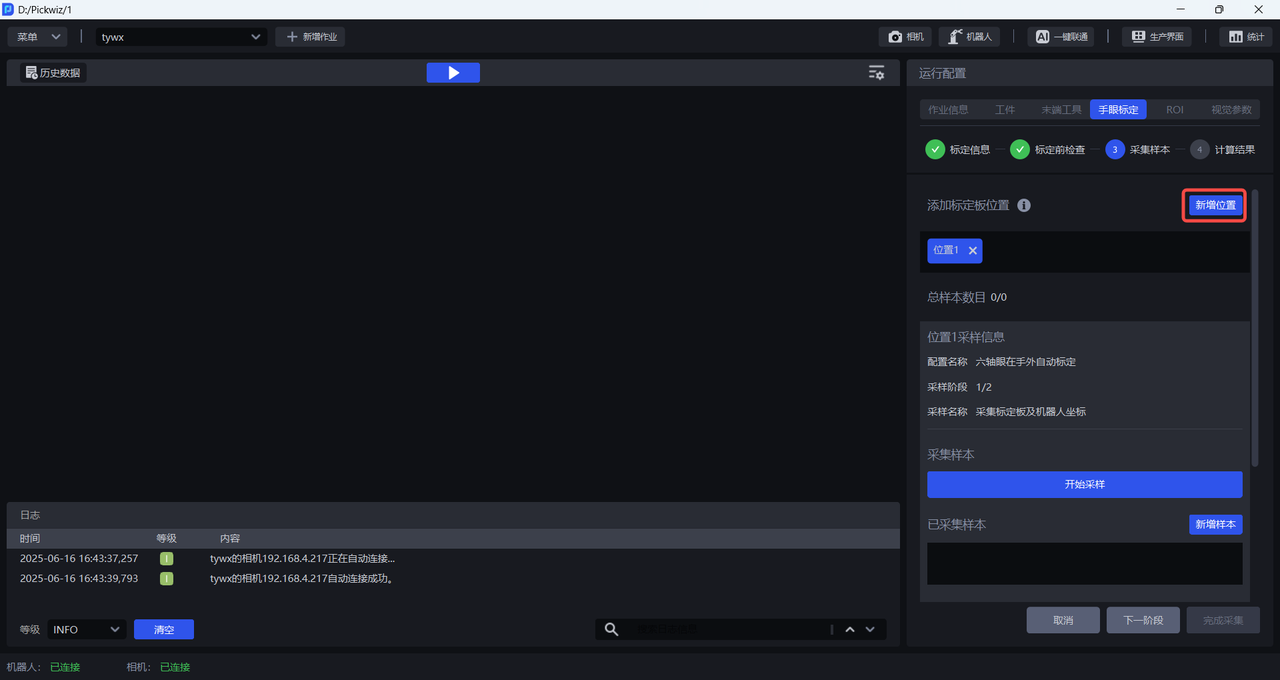
2.4.3 [Optional] Add a New Calibration Position
During the calibration sampling stage, the system uses the single-pose calibration mode by default, but in specific application scenarios it can be extended to a multi-position calibration strategy, improving calibration robustness and system adaptability under complex working conditions:
To address accuracy deviations caused by depth-of-field changes in wide-angle vision systems, layered sampling along the Z-axis can effectively balance the error distribution across different focal planes;
In work environments with limited space, when a single Calibration Board placement cannot complete the collection of more than 3 feature points, multiple Calibration Board placements and batch sampling can be used to cumulatively meet the minimum sample size requirement.
Click Add Position to add a new calibration position, then repeat **2.4.1 Collect Calibration Board and Robot Coordinates **and **2.4.2 Touch the Calibration Board with the Pin Tip **for the collection of calibration samples and Calibration Board contact-point sampling.
2.4.4 Calculate Calibration Results
Click Calculation Results. PickWiz calculates the calibration results based on the collected samples. If the calibration error does not meet the requirements, perform Calibration Result Inspection and Analysis.
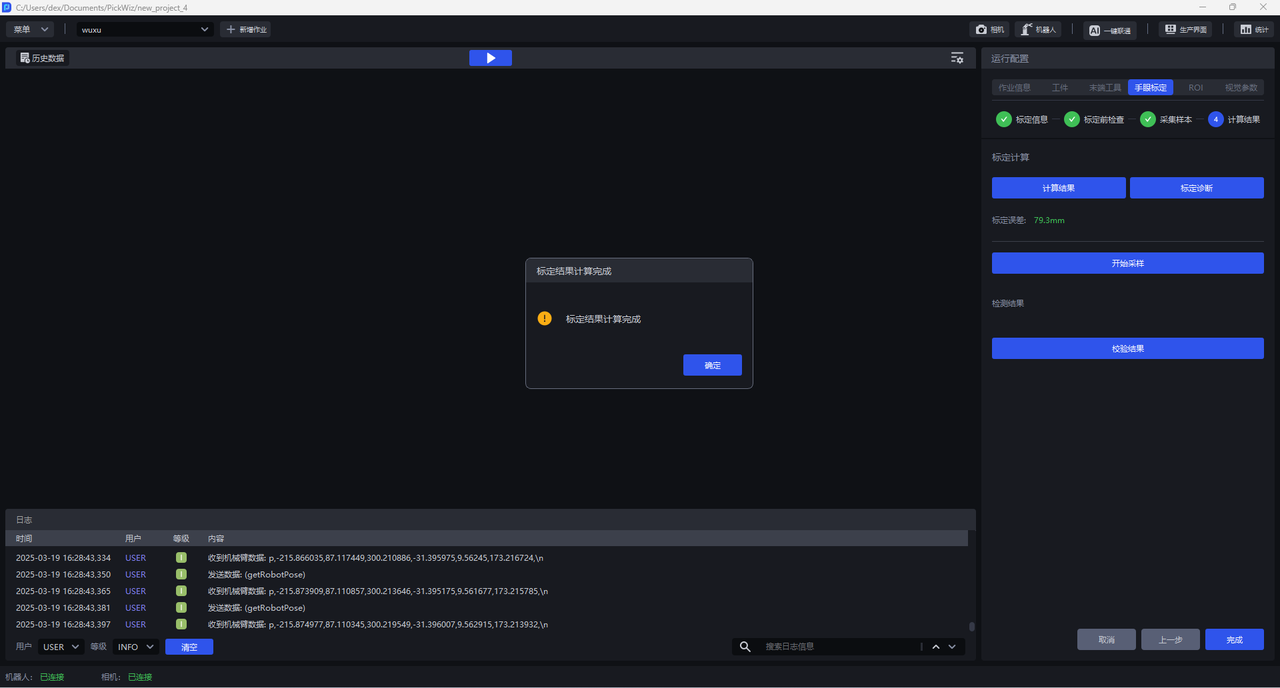
2.5 Calibration Result Inspection and Analysis
If Calibration Error exceeds the normal range, the cause of the error must be identified. Click Calibration Diagnosis, and refer to Calibration Result Inspection and Analysis to analyze the calibration results, resolve the issue, and check again until the calibration accuracy meets the scenario requirements.
2.6 Select the Eye-Hand Calibration Configuration
After the Calibration Workflow is complete, return to the Run Configuration interface, click Job Information, click the dropdown list for Eye-Hand Calibration, and select the corresponding eye-hand calibration configuration.