Calibration Verification
Before calibration, the impact of the following three factors on calibration result errors must be eliminated:
First, there may be errors in the camera Intrinsic Parameter, including lens focal length, principal point coordinates, and distortion coefficients. These errors can distort image information and then affect the accuracy of the calibration results. To address this type of error, camera accuracy must be corrected to ensure the accuracy of the camera Intrinsic Parameter.
Second, there may be errors in the point cloud captured by the Camera, such as noise, missing data, or distortion, causing the point cloud to fail to truly reflect the pose of the workpiece. Usually, camera imaging parameters need to be adjusted so that the point cloud can truly reflect the workpiece pose and provide accurate data support for calibration.
Third, there may be errors in the Robot. Due to factors such as the mechanical structure of the robot arm and the precision of transmission components, the robot arm itself has absolute accuracy limitations, which can cause certain deviations when the Tool is positioned and thus affect the accuracy of the calibration results. Therefore, robot accuracy verification is required to reduce the errors introduced into the calibration process by the robot arm's accuracy limitations.
1. Correct Camera Accuracy
Before correcting camera accuracy, enable
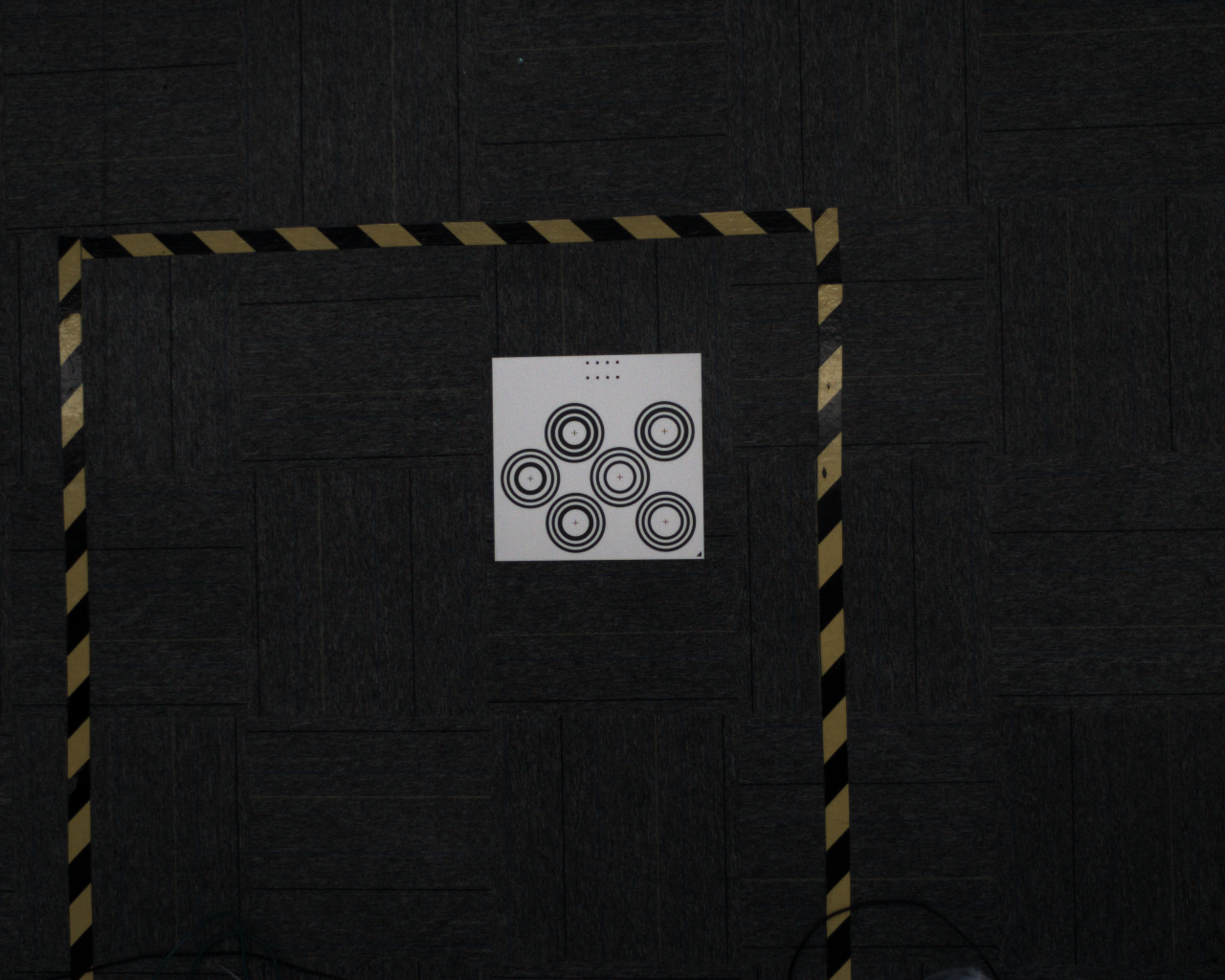
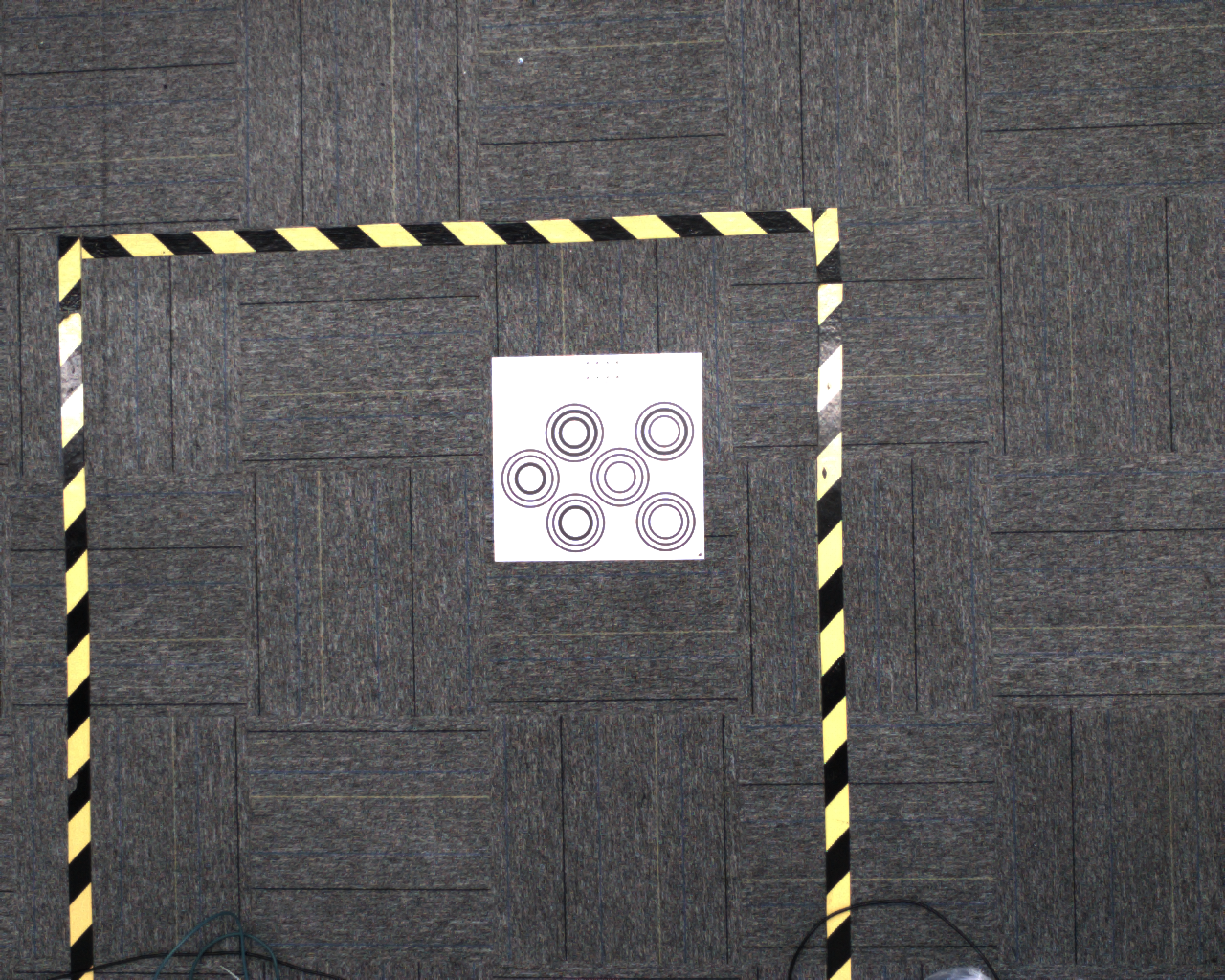
Show Overexposed Areasto check the exposure level of the camera image. If there are overexposed areas, adjust theExposure TimeunderSingle Exposureto ensure normal camera image exposure.After the correction is completed, the camera parameters should be switched back to the original configuration.
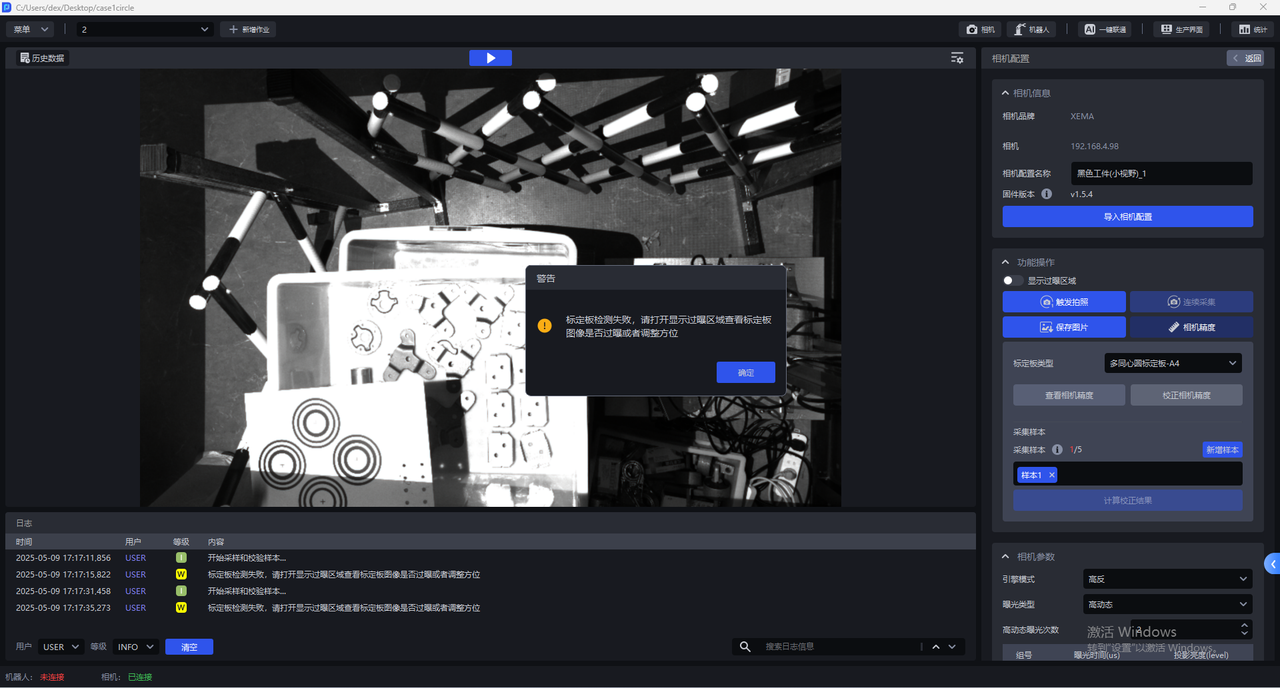
- Click
Camera Accuracyin the camera configuration interface
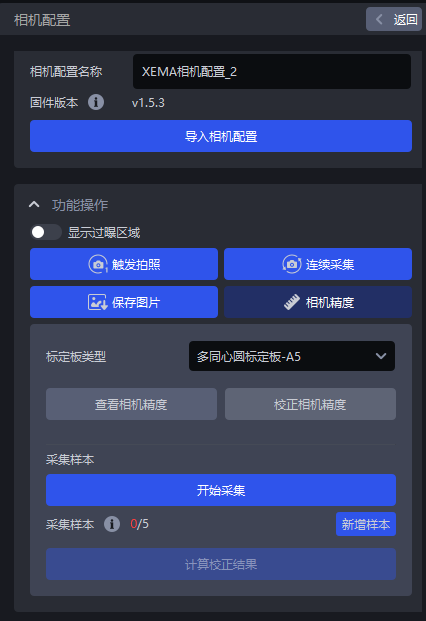
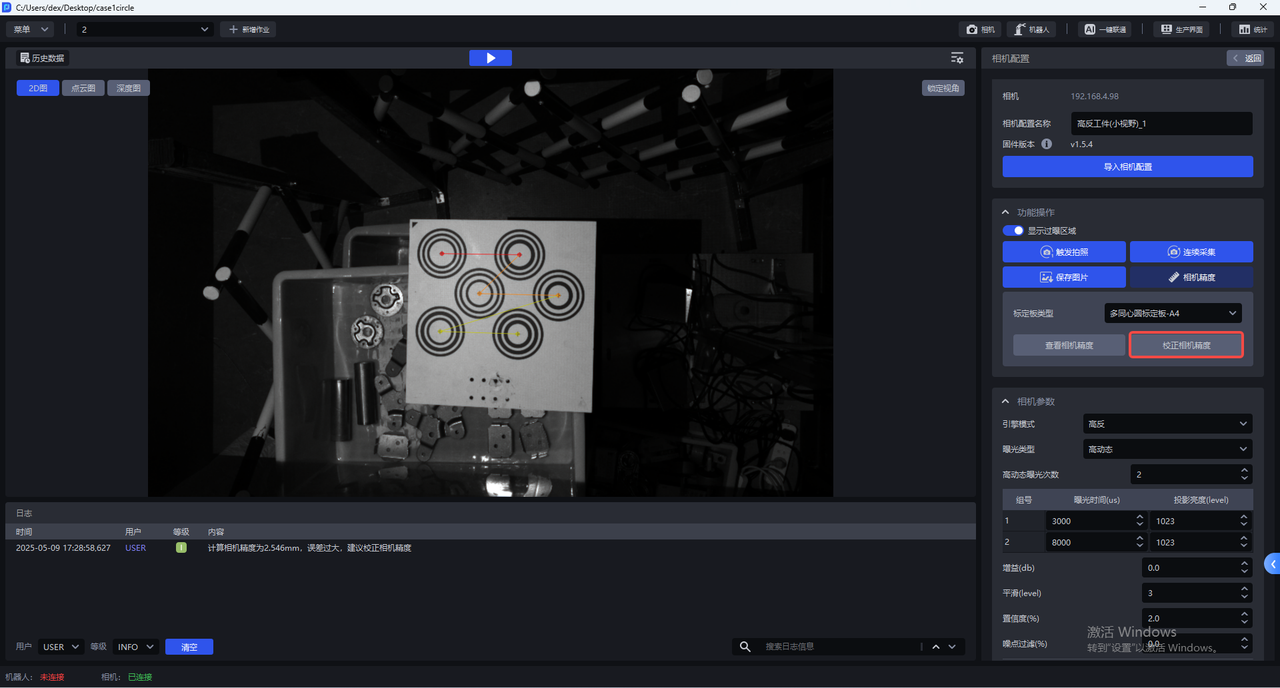
- Select the corresponding Calibration Board. If the selected Calibration Board does not match the actual one, a warning popup stating
Please Check Calibration Board Typewill appear, as shown below. In the example, the actual Calibration Board is A4. If A3 is selected as the Calibration Board type, a warning popup will appear.
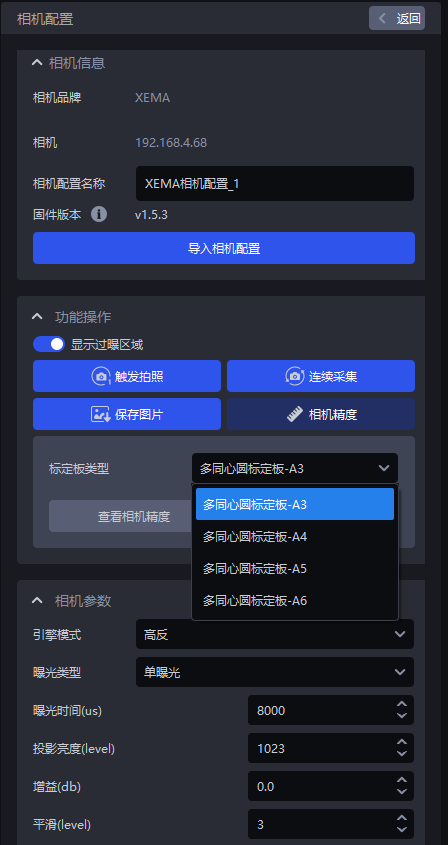
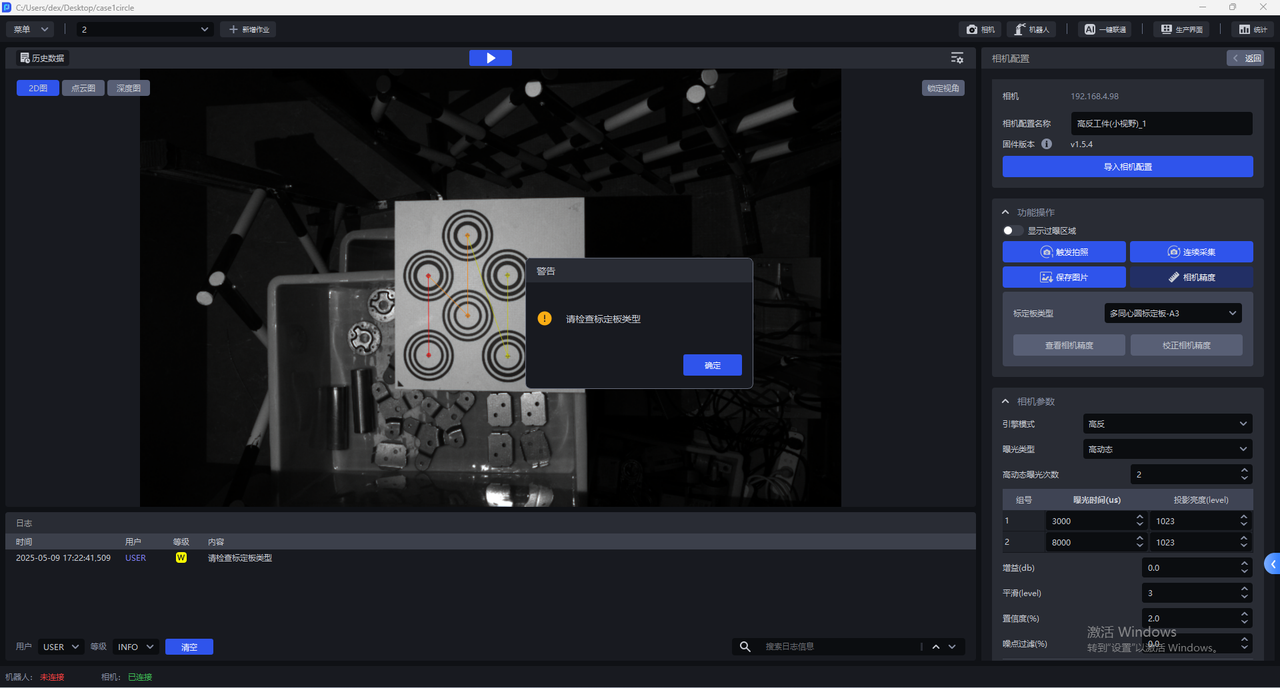
- After selecting the correct Calibration Board type, click
Correct Camera Accuracy
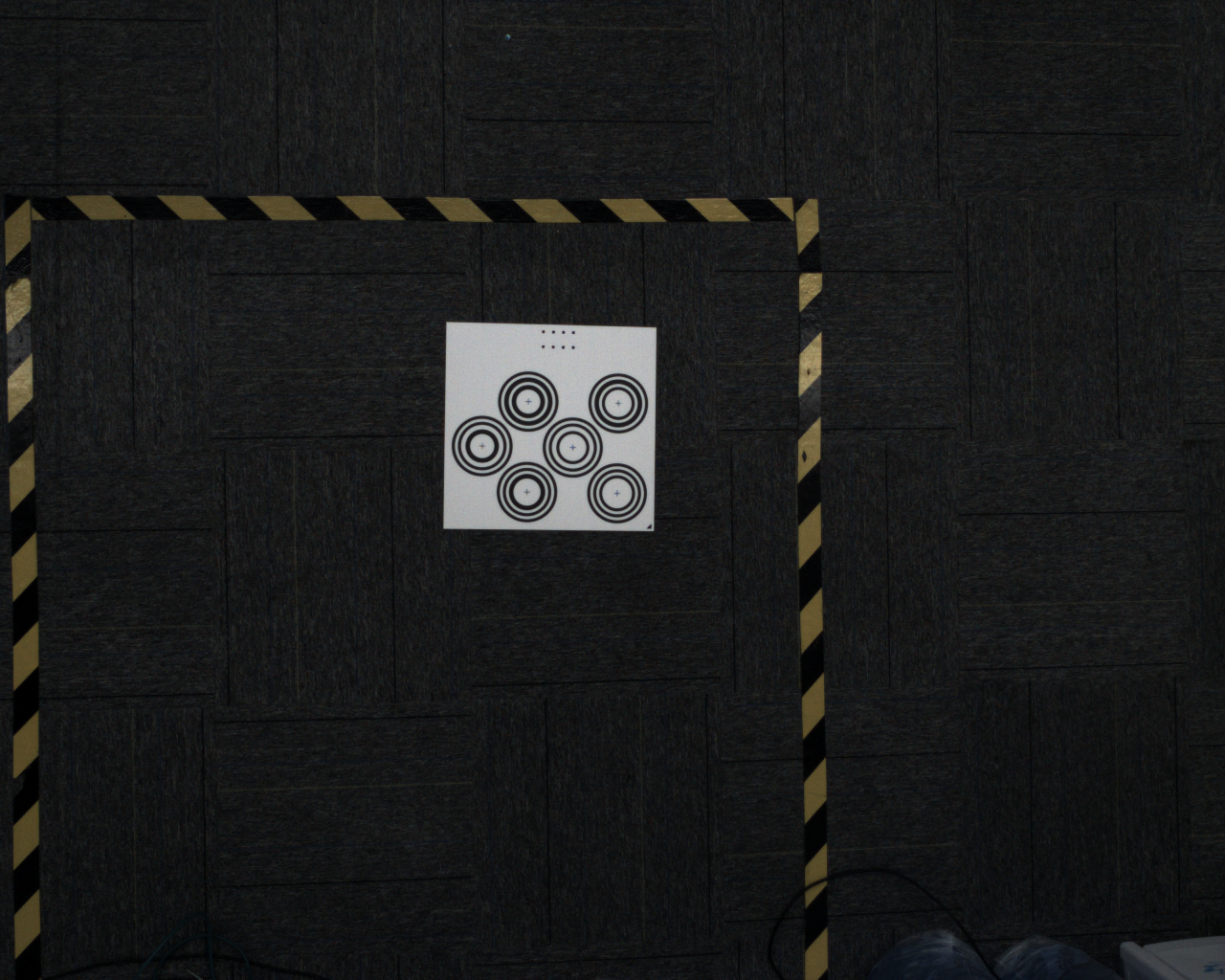
- Place the Calibration Board horizontally in the center of the Camera field of view, then click
Add Sample. The Camera starts sampling and verifying the sample. If the collected sample passes verification, it will be added belowCollected Samples, as shown below
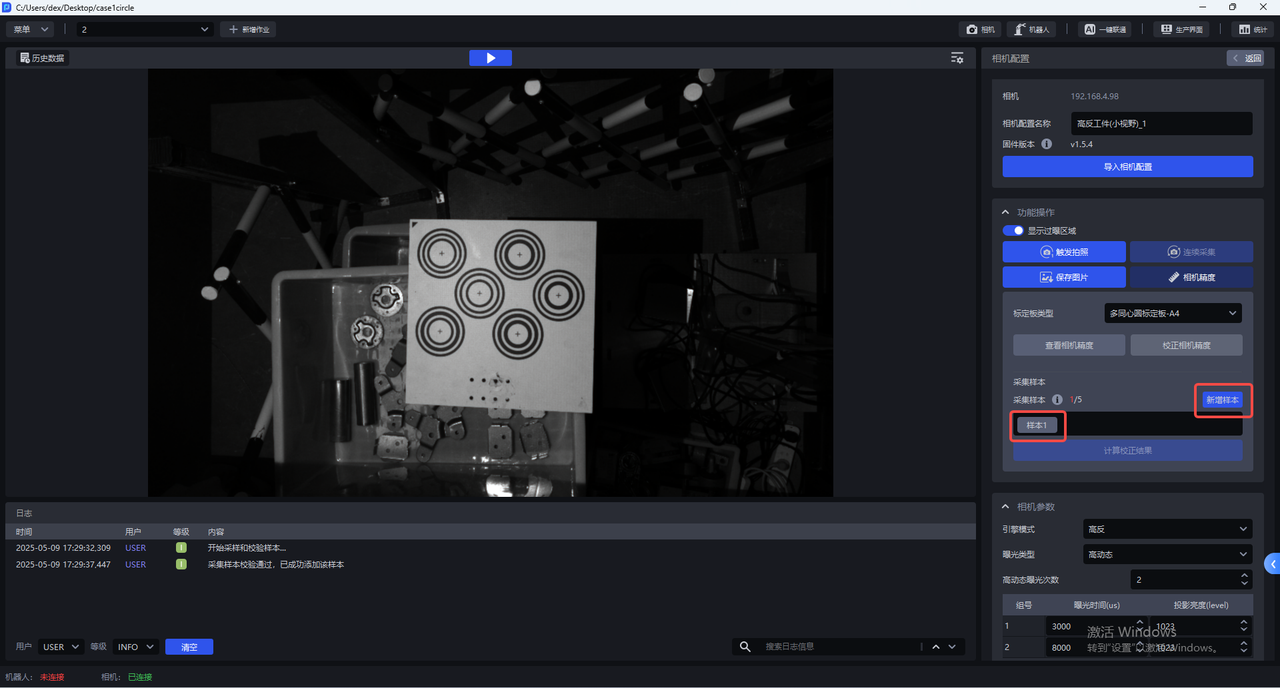
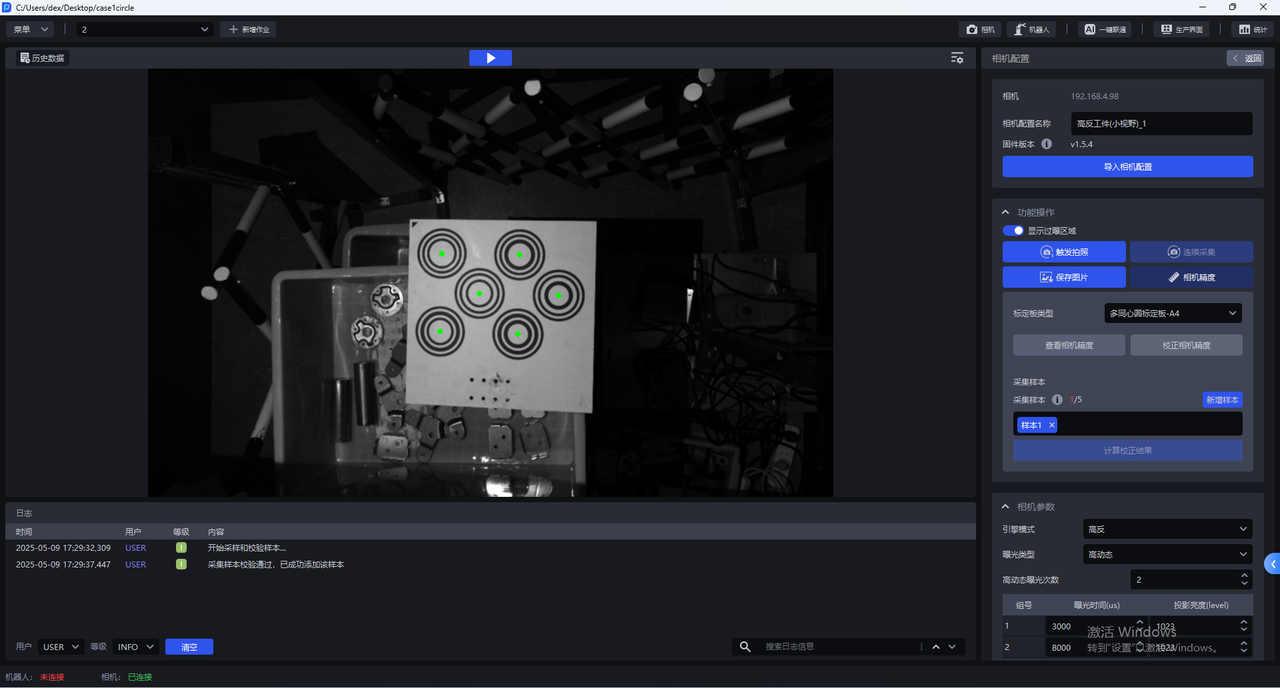
Click Sample x to view the collected sample. All concentric-circle centers on the Calibration Board in a verified sample will turn green.
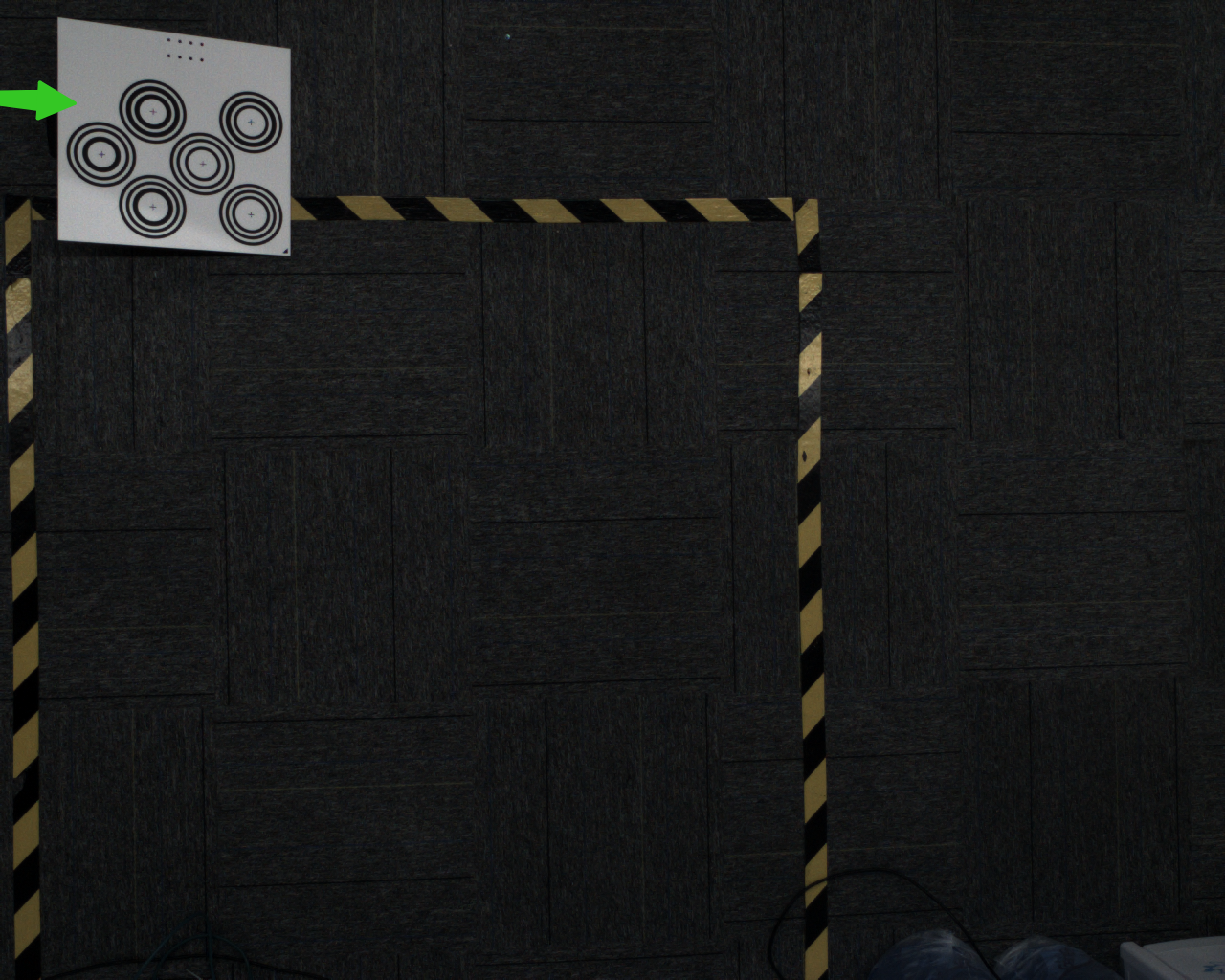
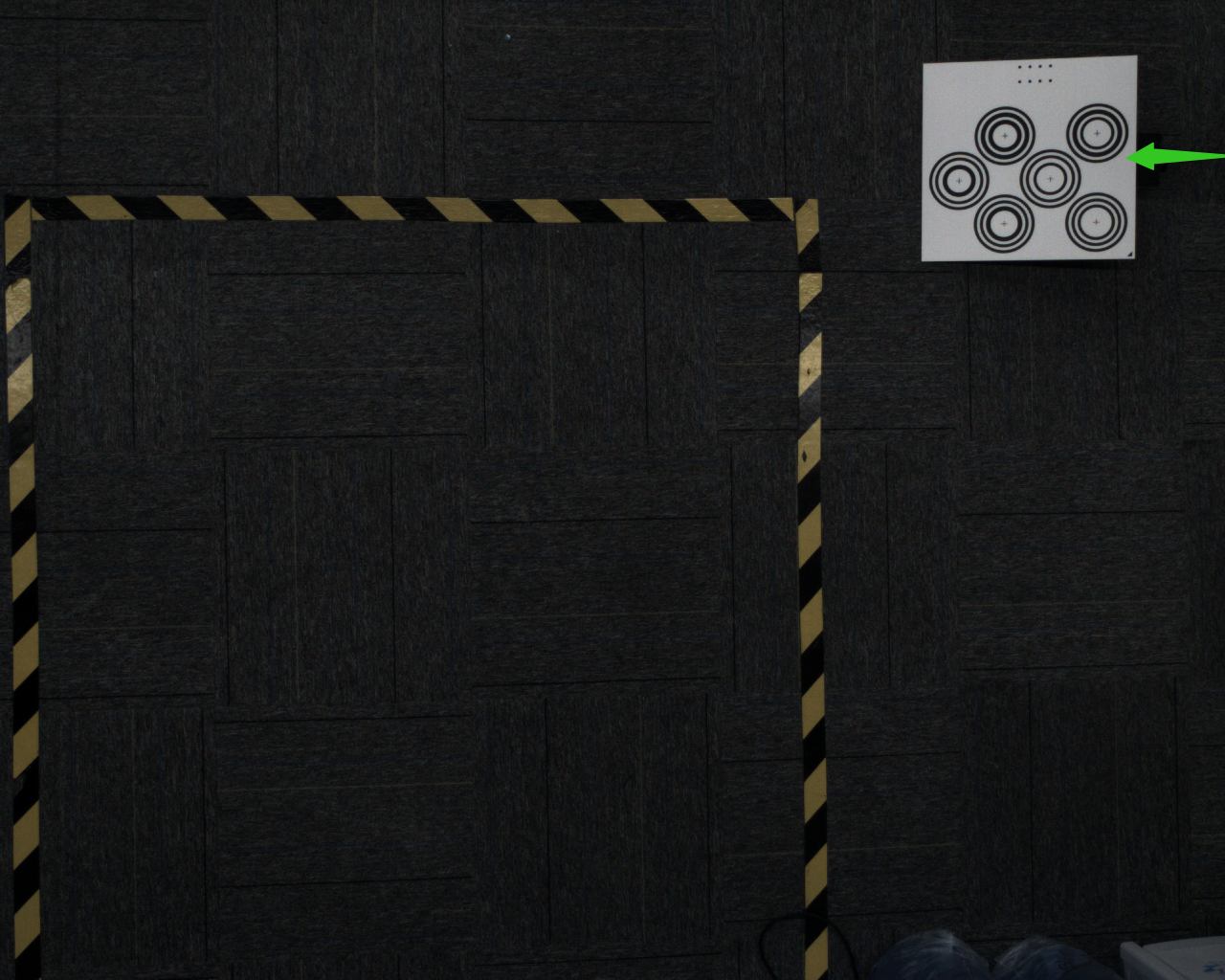
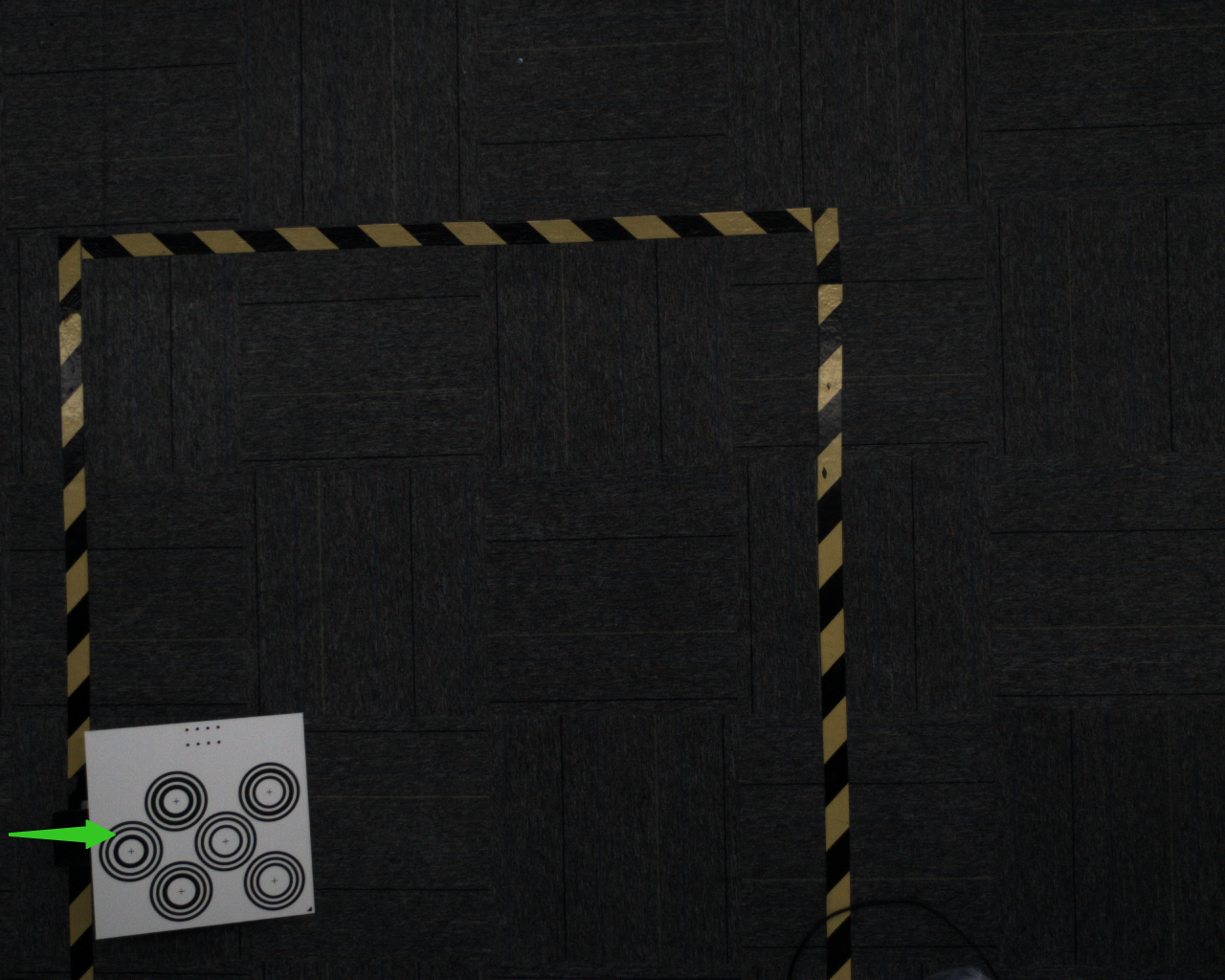
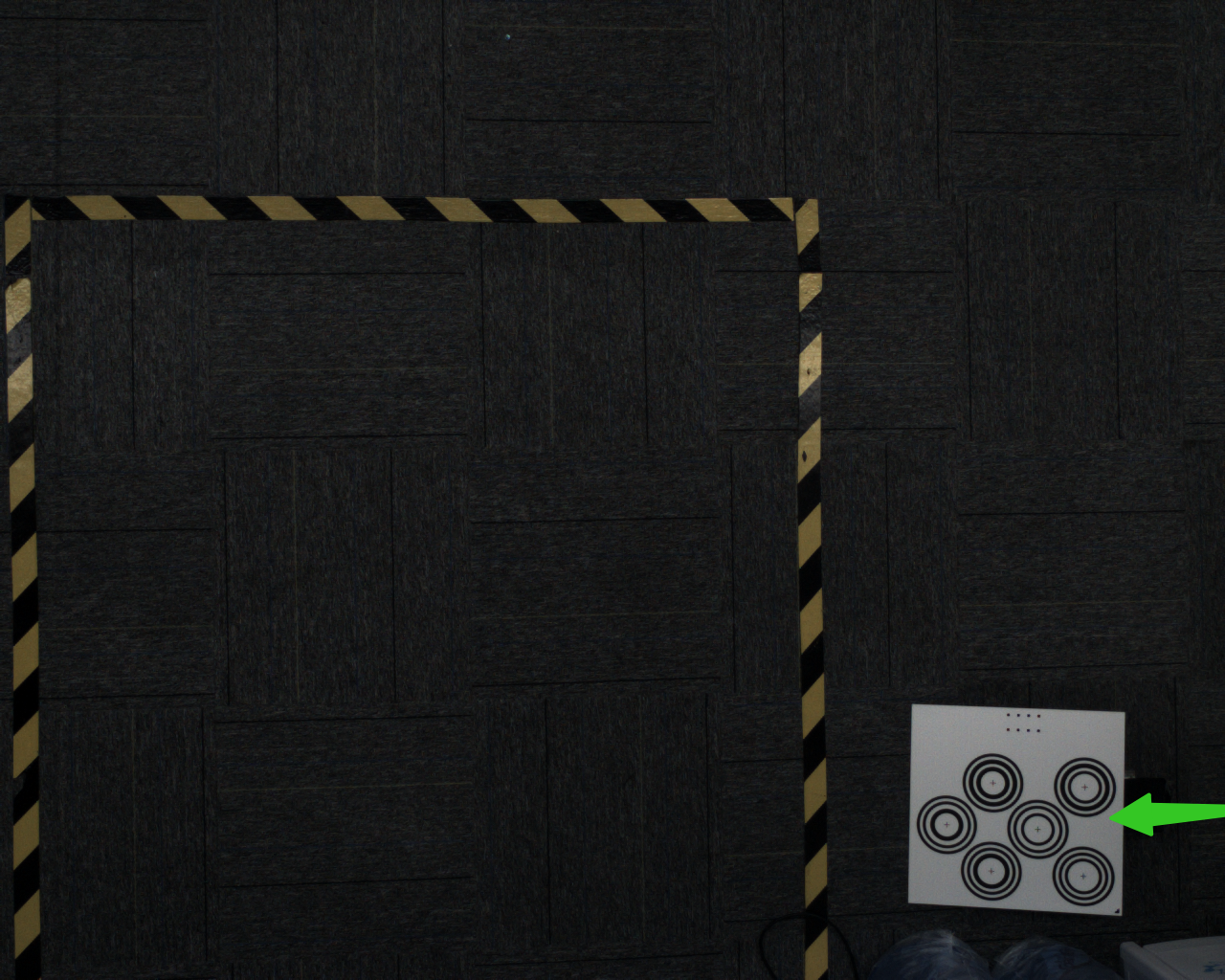
- Move the Calibration Board to the four corners within the Camera field of view and click
Add Sample. At each corner, prop the Calibration Board up at an angle. The Calibration Board placement angle should be 15-30°, and the tilt angle must not be too large or too small.
- After adding 5 samples, click
Calculate Correction Results
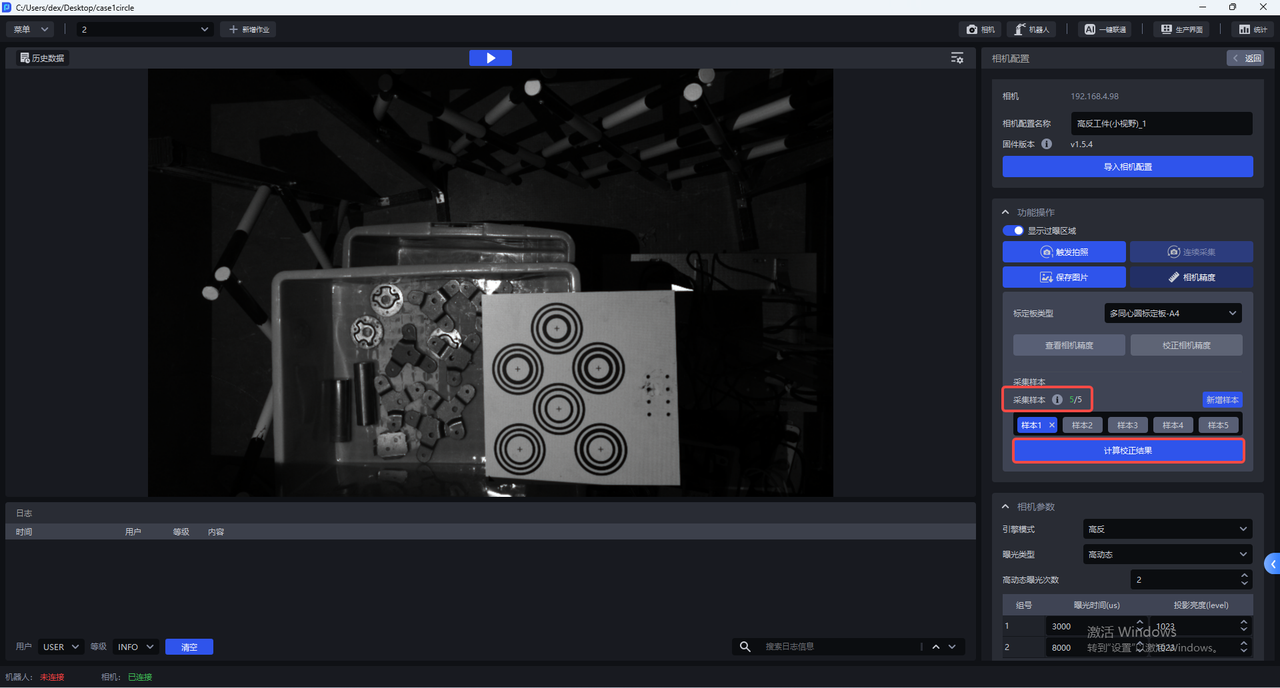
- After the correction is completed, a prompt box will pop up stating
Camera accuracy correction completed, correction accuracy is x, error is normal. Overwrite the current camera parameter configuration?
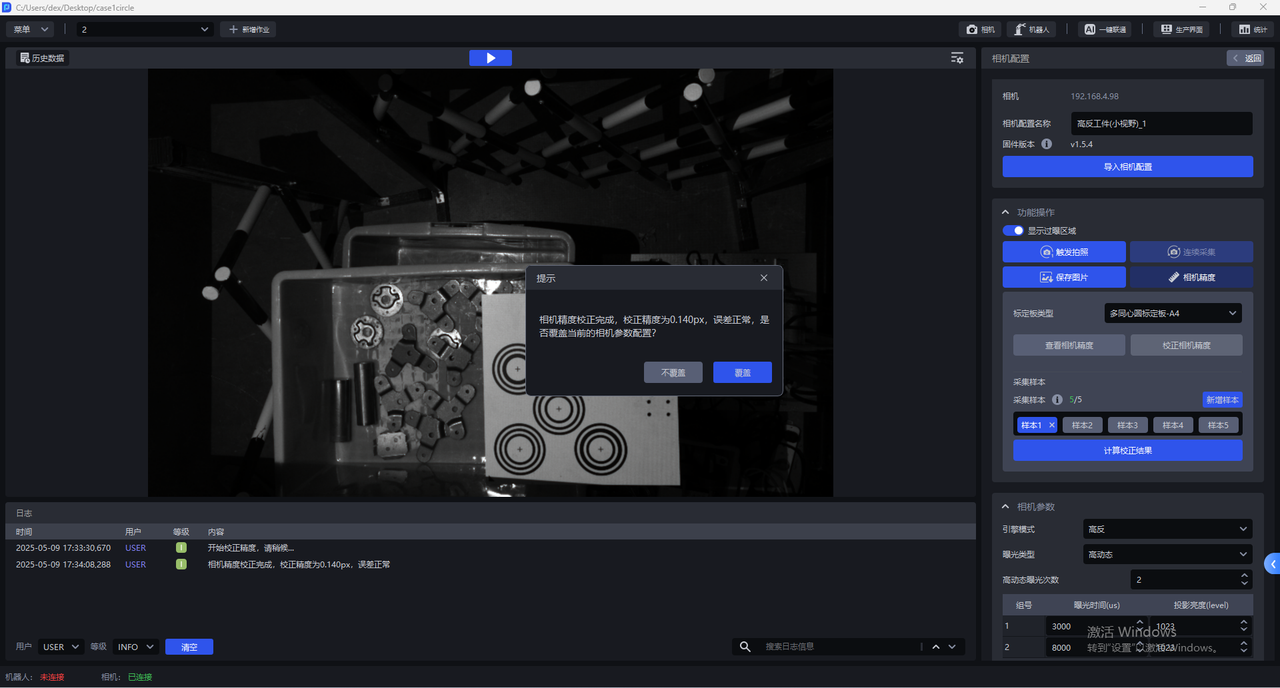
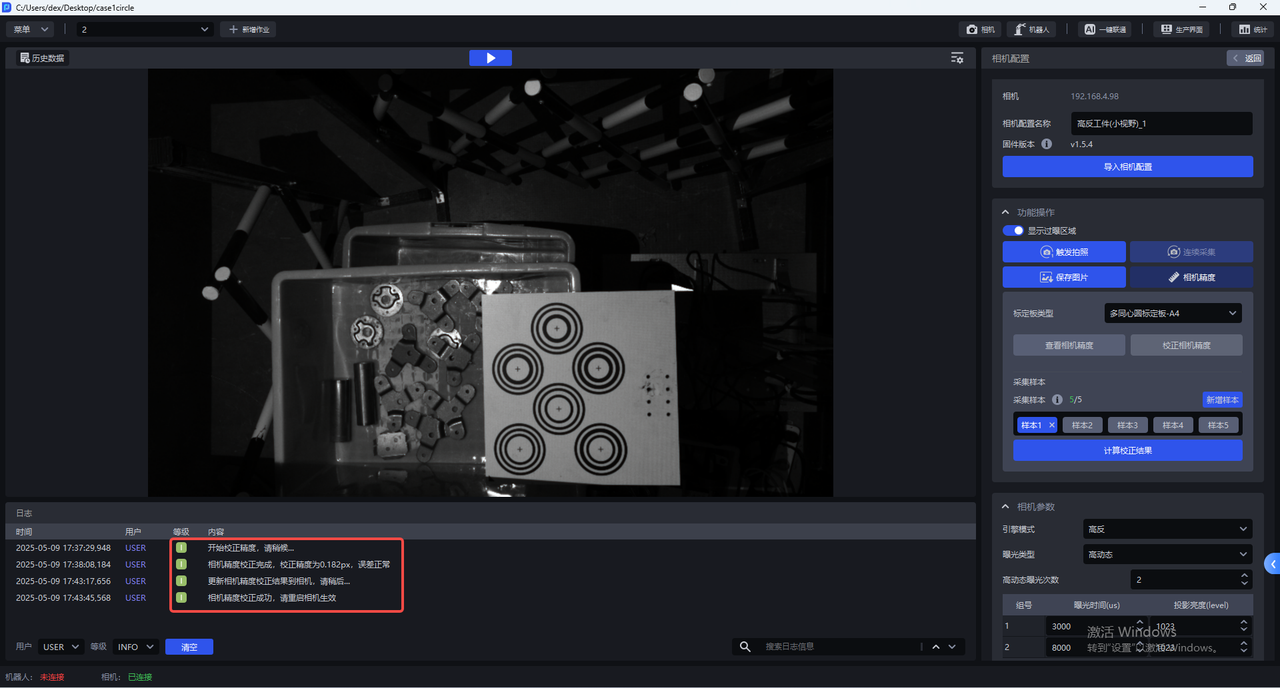
If you choose to overwrite the current camera parameter configuration, the camera accuracy correction result will be updated to the Camera, and the Camera must be restarted for it to take effect
2. Adjust Camera Imaging Quality
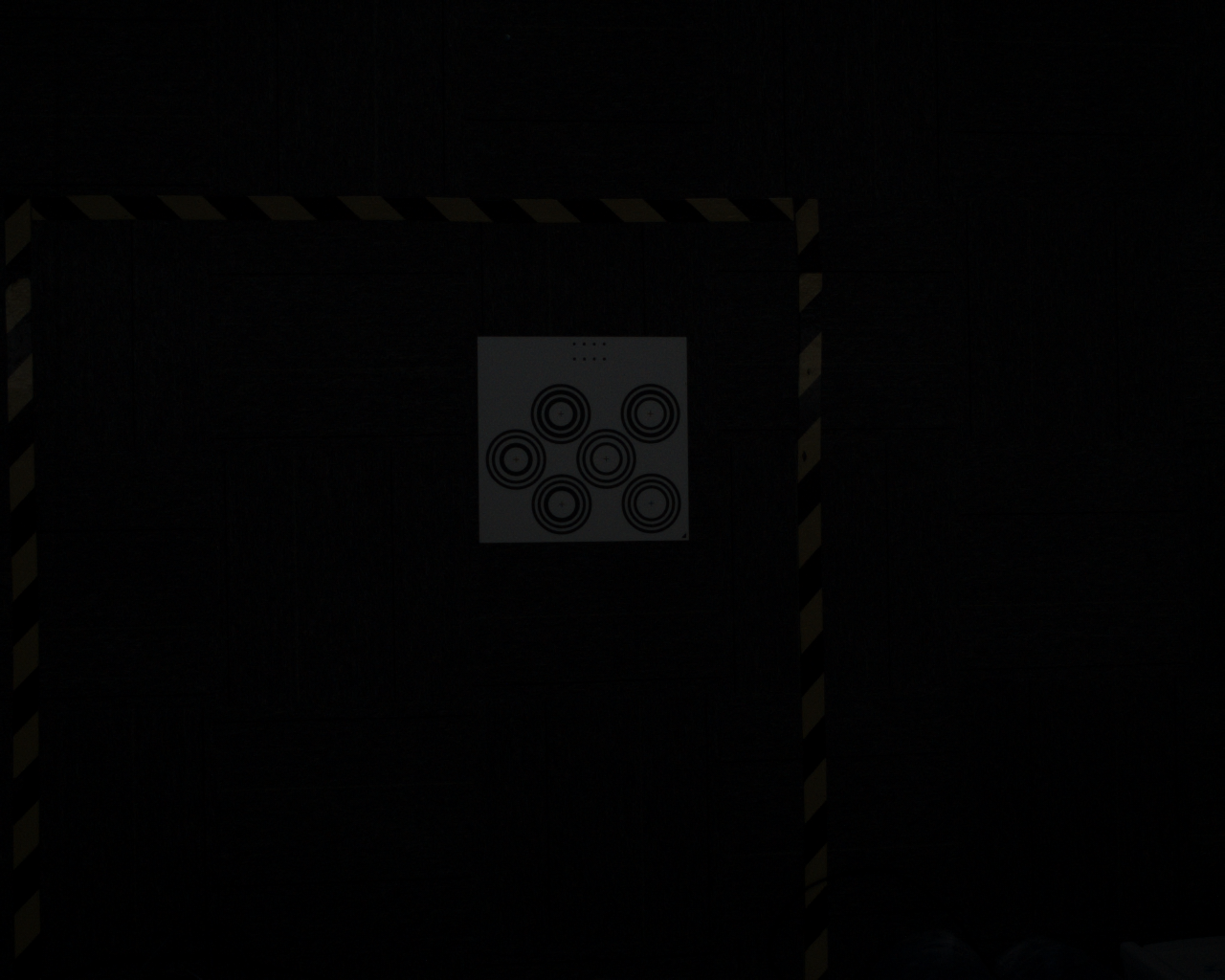
In the Camera Configuration interface, for Xema, Finch, and Sparrow series cameras, refer to Camera Connection and Parameter Tuning Guide to adjust camera parameters. For Kingfisher series cameras, refer to KINGFISHER Series Camera User Manual to adjust camera parameters until the Calibration Board exposure is normal, the amount of noise is reduced, and the imaging quality is improved.
3. Robot Accuracy Verification
Before calibration, it is necessary to confirm whether the robot accuracy meets the project requirements. If it does not, robot accuracy must be verified before calibration;
If the camera accuracy meets the requirements and the imaging quality also meets the requirements, but the calibration result error is still very large, then robot accuracy verification is required.
3.1 Robot Accuracy Verification for Eye to hand
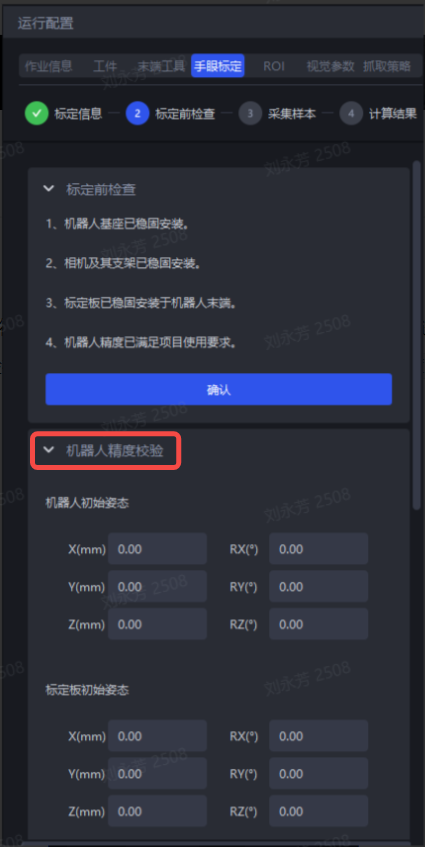
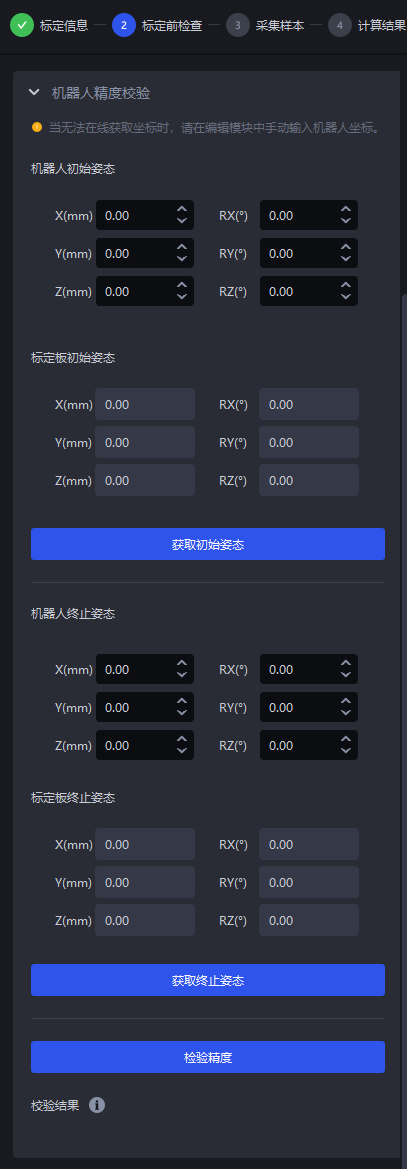
For Eye-to-Hand calibration, robot accuracy verification is performed during the Pre-Calibration Check stage by opening Robot Accuracy Verification
- Step 1: Click
Get Initial Pose. The Camera captures an image to recognize the Calibration Board, andInitial Calibration Board Posewill update to the corresponding Calibration Board Pose. If the Camera cannot recognize the Calibration Board, control the robot arm carrying the Calibration Board to move and recognize the Calibration Board again.
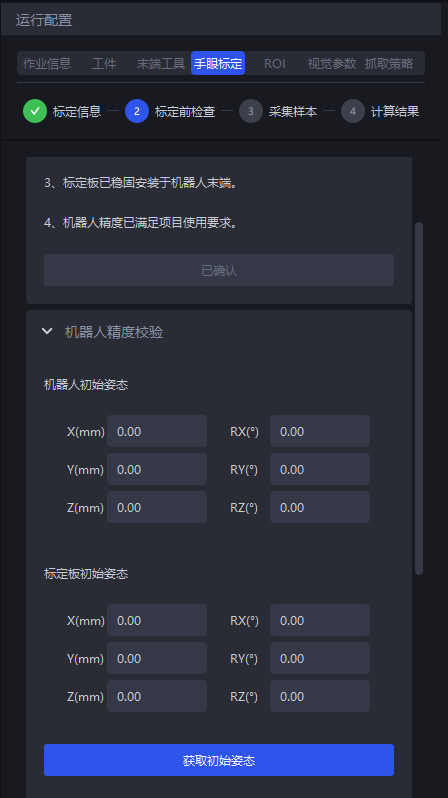
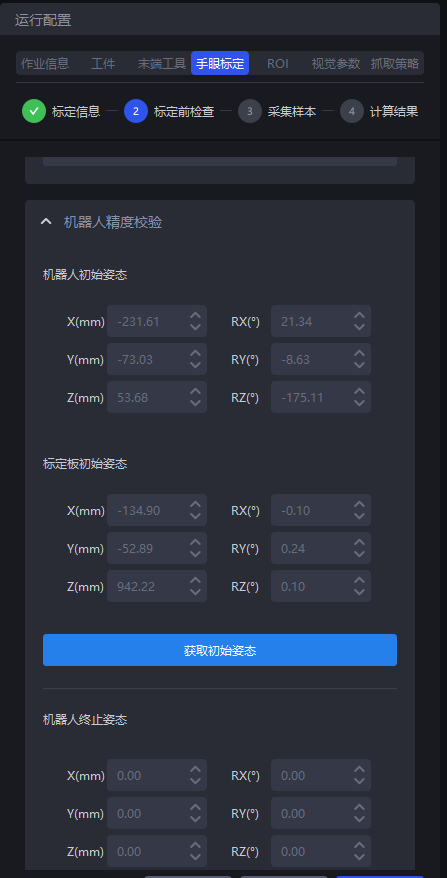
If Get Coordinates Online is Yes, PickWiz will send a request-pose command to the Robot, and the Robot will send the current end pose of the robot arm to PickWiz. Initial Robot Pose will update to the current end pose of the robot arm, as shown below.

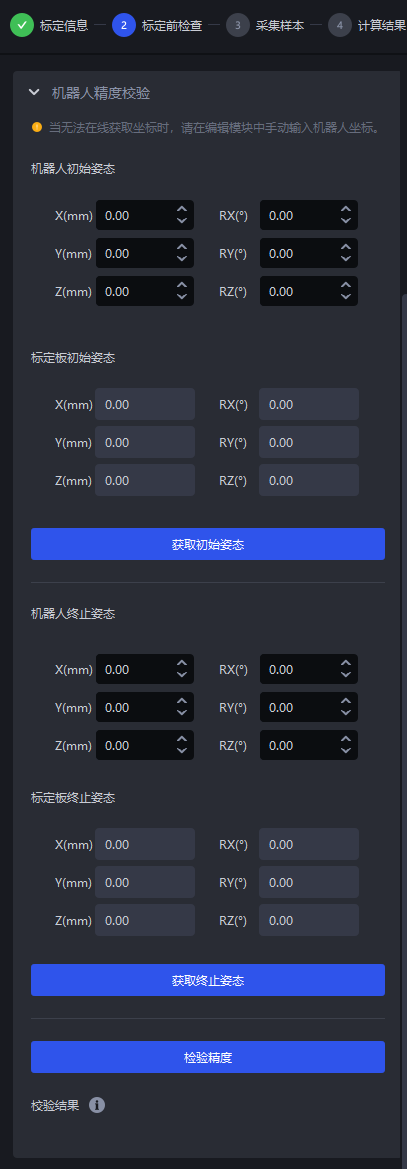
If Get Coordinates Online is No, the current end pose of the robot arm must be entered manually, as shown below.
- Step 2: Control the robot arm carrying the Calibration Board to translate a relatively long distance, then click
Get Final Pose. The Camera captures an image to recognize the Calibration Board, andInitial Calibration Board Posewill update to the corresponding Calibration Board Pose. If the Camera cannot recognize the Calibration Board, control the robot arm carrying the Calibration Board to translate and recognize the Calibration Board again.
During robot accuracy verification, control the robot arm carrying the Calibration Board to translate in the X or Y direction, and there must be no rotation in any direction
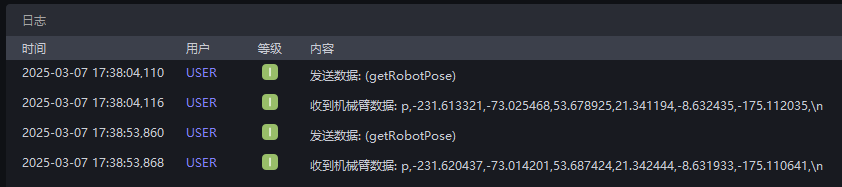
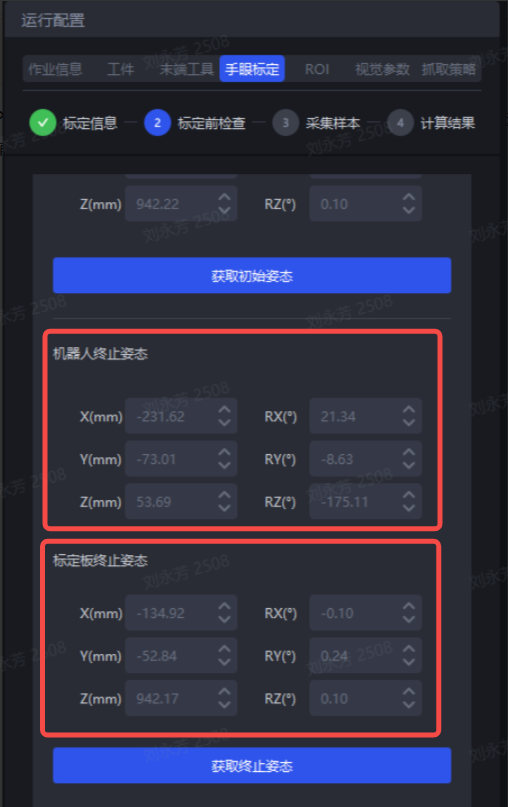
If Get Coordinates Online is Yes, PickWiz will send a request-pose command to the Robot, and the Robot will send the current end pose of the robot arm to PickWiz. Final Robot Pose will update to the current end pose of the robot arm, as shown below.
If Get Coordinates Online is No, the current end pose of the robot arm must be entered manually, as shown below.
- Step 3: Click the
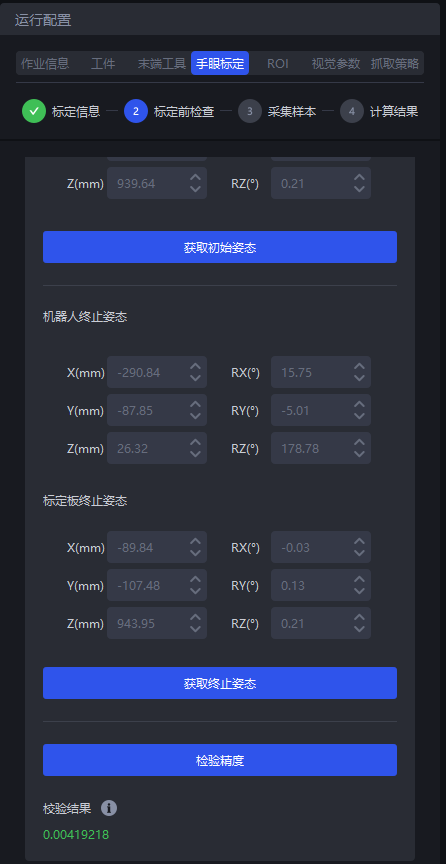
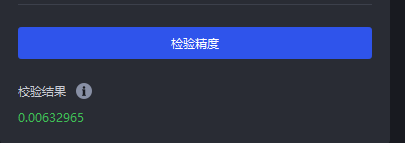
Verification Accuracybutton to view the robot verification accuracy (absolute accuracy ratio). This value must not be greater than 0.005. Otherwise, the robot arm can be considered to have an absolute accuracy issue, as shown below. (The ratio is calculated as(1 - translation distance of Calibration Board / translation distance of robot arm).)
3.2 Robot Accuracy Verification for Eye in hand
For Eye-in-Hand calibration, robot accuracy verification is completed before calibration.
Step 1: Place the Calibration Board flat on a horizontal work platform. Move the end of the robot arm so that it is vertically aligned with the center of one concentric circle on the Calibration Board. Record the position of the Calibration Board at this time as the initial position of the Calibration Board, and record the pose on the robot teach pendant as the initial robot pose.
Step 2: Translate the Calibration Board by a relatively long distance in the X or Y direction, and control the robot arm to translate in the same direction as the Calibration Board so that the end of the robot arm remains vertically aligned with the center of the same circle on the Calibration Board. Record the translated position of the same circle center on the Calibration Board as the terminal position of the Calibration Board, and record the pose on the robot teach pendant as the terminal pose.
After translation, the end of the robot arm should be vertically aligned with the center of the same circle on the Calibration Board
The end of the robot arm should translate in the X or Y direction, and there must be no rotation in any direction
Step 3: Calculate the translation distance of the end of the robot arm from the initial pose to the terminal pose, and use a graduated distance-measuring tool to manually measure the translation distance of the Calibration Board from the initial position to the terminal position.
Step 4: Robot accuracy = (translation distance of the end of the robot arm from the initial pose to the terminal pose) / manually measured translation distance of the Calibration Board. If the calculated robot accuracy is ≤0.005, the robot accuracy is considered to meet the requirements; otherwise, it is considered not to meet the requirements.