Automatic Random Pose Sampling
PickWiz 1.7.3+ supports "automatic random pose sampling"; this calibration method is not currently supported for three-axis or four-axis Robots.
1. Preparation Before Calibration
Before starting eye-hand calibration, complete the following preparations:
(1) Complete the 3D Vision Guidance Kit hardware setup
Please refer to 3D Vision Guidance Kit Hardware Setup to complete the installation and connection of the Robot, Camera, and IPC
(2) Create a Project and a task
Please refer to Project Operation Guide and Task Operation Guide to create a Project and a task.
(3) Complete Camera connection and parameter adjustment, and configure it in the task information
Please refer to Camera Connection and Parameter Adjustment Guide to connect the Camera, perform camera imaging quality adjustment, verify Camera accuracy, and configure it in the task information.
(4) Complete Robot communication configuration
Please refer to Robot Configuration and Communication Operation Guide to establish communication between the Robot and PickWiz. Automatic calibration requires two communication fields to be configured separately.
Robot sends the vision inspection command: add the following
Photo calculation type (${co}), set to 3 to indicate a request for automatic calibration
Robot pose (${p}), which represents the Robot sampling pose
Automatic calibration sampling sends the command: add the following
Calibration sampling result(${sr}): indicates the sampling result
Next sampling pose(${cp}): the Robot movement position for collecting the next calibration sample
(5) Prepare the materials required for calibration
- Prepare the required Calibration Board, and ensure that it is flat and clear, with no obvious scratches, dirt, bending, or deformation;
2. Calibration Information Configuration
Enter the eye-hand calibration interface, click Add Eye-Hand Calibration, and go to the calibration information configuration interface.
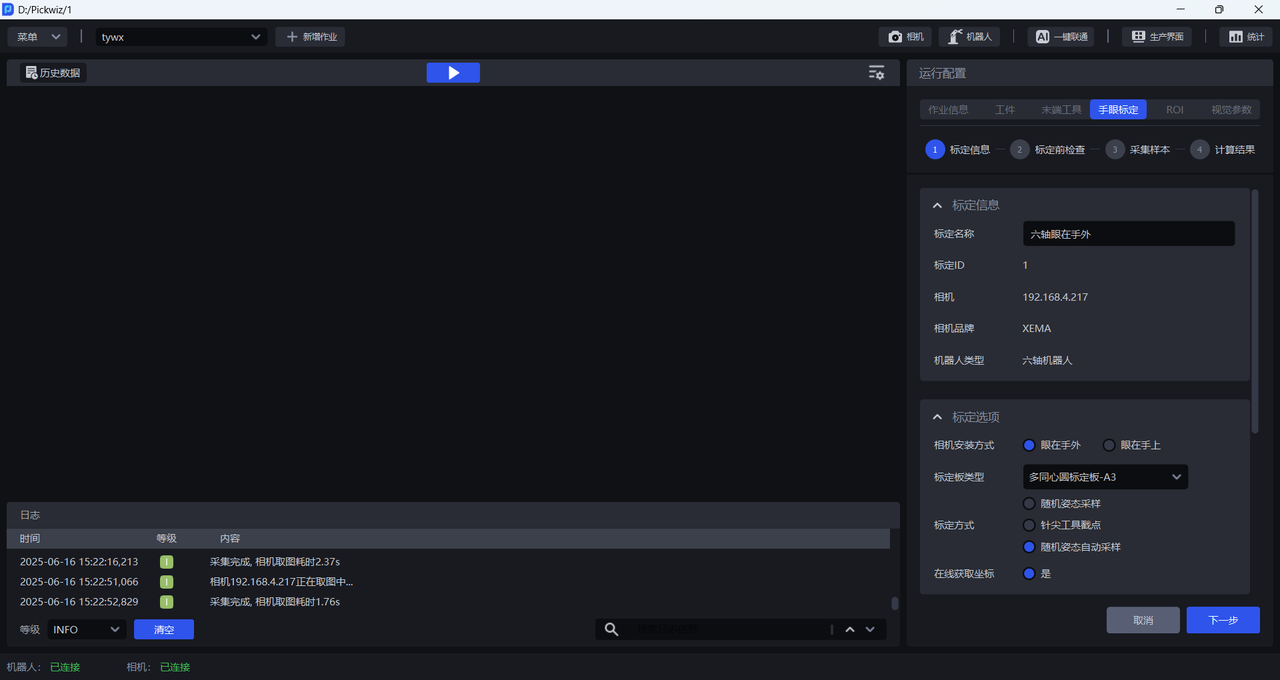
Calibration Namecan be used to name the current calibration configurationCalibration IDis used by the Robot to switch calibration configurationsCamerais the IP address of the currently connected CameraCamera Brandis the brand of the currently connected CameraRobot Typemust be consistent with the Robot type in Robot ConfigurationFor
Camera Installation Method, selectEye-to-HandFor
Calibration Board Type, select the current Calibration Board type
The appropriate Calibration Board mainly depends on the Robot type and Camera height. Please select a suitable Calibration Board according to the actual application scenario and the table below.
| Robot Type | Camera Mounting Height | Select Calibration Board |
|---|---|---|
| Six-axis Robot | Under 0.5 m | A6 Multi-Concentric-Circle Calibration Board |
| Under 1.5 m | A5 Multi-Concentric-Circle Calibration Board | |
| 1.5 m -- 2.5 m | A4 Multi-Concentric-Circle Calibration Board | |
| Over 2.5 m | A3 Multi-Concentric-Circle Calibration Board | |
| Three-axis/Four-axis Robot | Under 0.5 m | A6 Multi-Concentric-Circle Calibration Board |
| Under 1.5 m | A5 Multi-Concentric-Circle Calibration Board | |
| 1.5 m -- 2.5 m | A4 Multi-Concentric-Circle Calibration Board | |
| Over 2.5 m | A3 Multi-Concentric-Circle Calibration Board |
For
Calibration Method, selectRandom Pose Sampling CalibrationFor
Get Coordinates Online** **selectYesAutomatic calibration sampling distribution
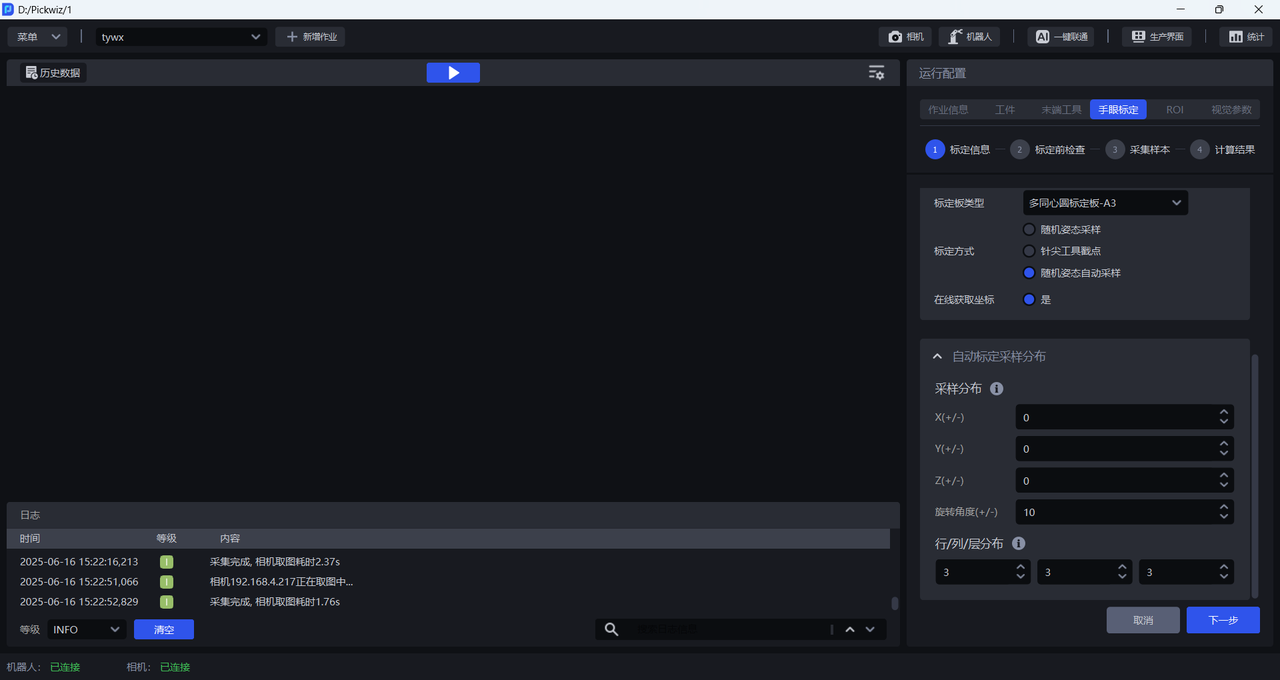
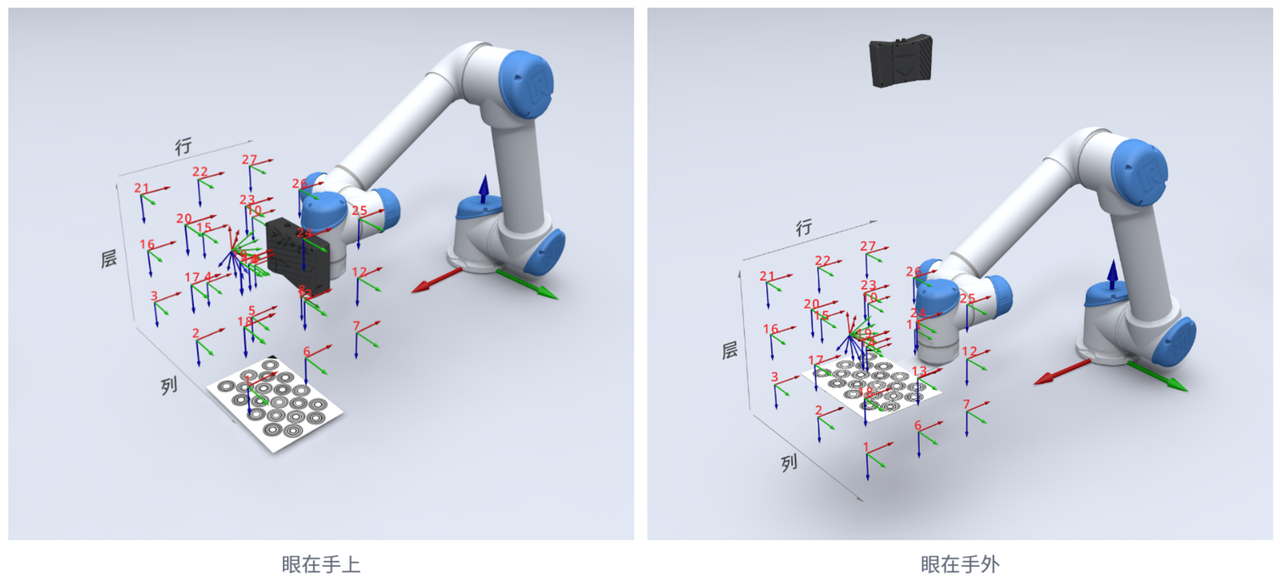
Sampling Distribution: With the current position as the origin (based on the Robot coordinate system), you can set the Robot sampling range along the positive and negative X/Y/Z axes, as well as the rotation sampling angle relative to the Initial Pose. Make sure the sampling range stays within the Camera field of view, avoids collisions, and leaves appropriate clearance. The units are (mm) and (°).
Row/Column/Layer Distribution:
You can set the number of row/column/layer distribution points for sample collection within the Robot sampling range.
The default row/column/layer distribution is 3x3x3. If accuracy permits, it can be reduced to smaller combinations such as 2x2x3. It is recommended that each distribution count be 2~3. The unit is (count).
3. Checks Before Calibration
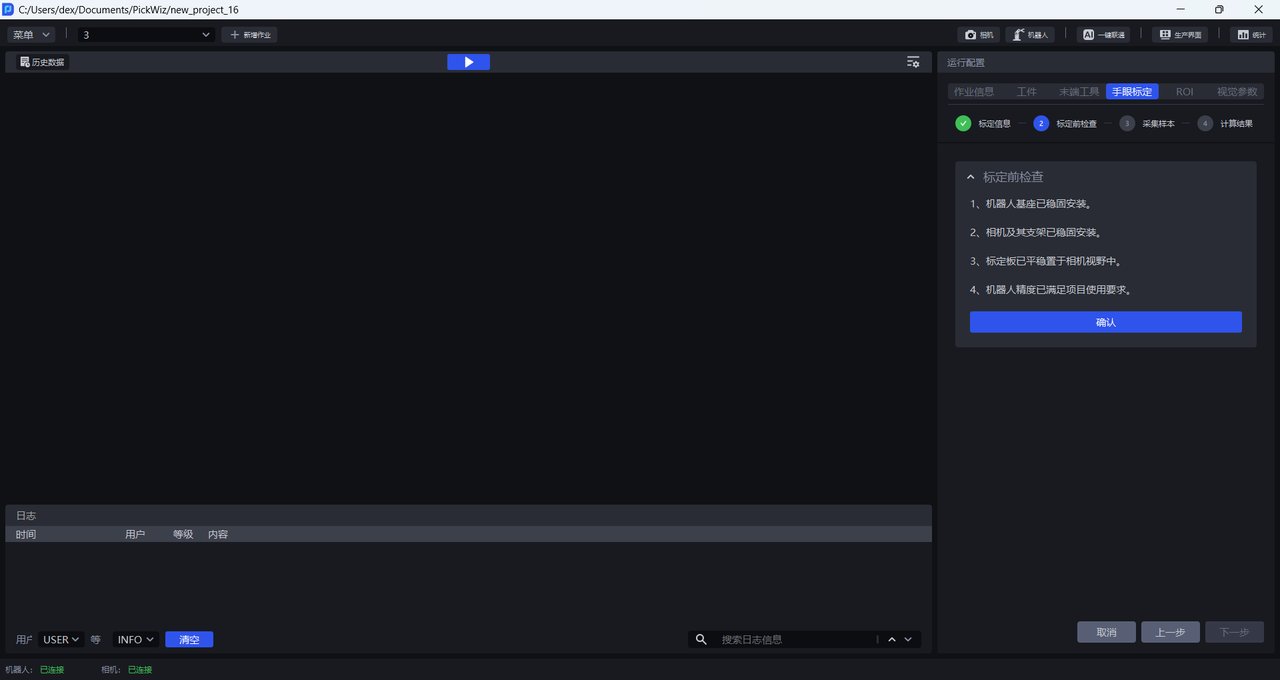
- Ensure that the Robot base is securely installed
Before starting eye-hand calibration, carefully inspect the installation of the Robot base. If the Robot base is not firmly installed, the Robot may shake noticeably during movement, affecting Robot accuracy and therefore the calibration result.
Check whether the Robot base installation meets the requirements as follows:
First, the surface where the Robot base is installed must be flat and kept clean;
Second, operate the Robot at 100% speed with large translational or rotational movements and observe whether there are signs of shaking. If shaking is present, readjust and secure the Robot base to ensure that no displacement or tilting occurs during Robot movement;
Third, check whether the Robot body and the base are tightly connected, and tighten the screws to prevent loosening.
- Ensure that the Camera and its bracket are securely installed
Before starting eye-hand calibration, carefully inspect the installation of the Camera and its bracket. If the Camera or its bracket is not firmly installed, Camera imaging quality will be affected, which in turn will affect the calibration result.
Check whether the Camera and its bracket installation meets the requirements as follows:
First, check whether the Camera bracket is a machined part, and avoid using aluminum profiles as the bracket material;
Second, shake the bracket and observe whether there is any obvious wobbling. If so, readjust and secure the bracket;
Third, shake the Camera and observe whether there is any obvious wobbling to ensure that the Camera is firmly installed.
- Ensure that the Calibration Board is stably placed within the Camera field of view
When the Camera installation method is Eye to hand, the Calibration Board must be mounted on the Tool and kept within the Camera field of view.
- Ensure that the Robot accuracy meets the project requirements
If the Robot accuracy does not meet the project requirements, refer to Calibration Verification to correct Robot accuracy.
4. Collect Samples
4.1 Collect Multiple Sets of Calibration Board and Robot Coordinates
This process completes a closed-loop calibration workflow triggered by the Robot. On the Robot side, special attention must be paid to Initial Pose calibration and real-time status feedback to ensure uniform spatial distribution of sampling data and system robustness.
4.1.1 Definition of Parameters Used in Robot Configuration
Robot vision inspection command
p: the current Robot pose coordinates
co: photo calculation type (a fixed value of 3 indicates automatic calibration sampling)
PickWiz automatic calibration sampling command
sr: sampling result status code (determines the workflow path)
cp: coordinate command for the next sampling point (the default value indicates termination)
4.1.2 Operating Procedure
Initialization Configuration
Enter the Robot configuration interface and complete this one-time setup:
Vision Inspection Send CommandandAutomatic Calibration Sampling Send CommandEnable the current Robot configuration scheme
Startup Preparation
Select the calibration configuration and enter the sampling page
Move the Robot to the Initial Pose
Initial Pose Calibration: The Calibration Board must be kept in the central area of the Camera field of view to ensure uniform sample distribution
Automatic Sampling Stage
Trigger the first inspection through the Robot communication program:
Different brands require different standard communication programs. Confirm before deployment whether a program is available.
The Robot sends a vision inspection command containing
p=Initial Poseandco=3PickWiz automatically generates the sampling distribution, records the first sample, and returns the
srstatus code and the newcpcoordinates
Repeat the following steps in a loop:
The Robot moves to the new pose based on the returned
srstatus code andcpcoordinatesThe Robot sends PickWiz a vision inspection command containing
p=Current Poseandco=3PickWiz performs sampling and returns the
srstatus code and the newcpcoordinates to the RobotSampling ends automatically when the Robot determines that
cphas the default value (empty value)
Different calibration sampling results correspond to different signal values, as follows:
0:automatic sampling completed successfully
1: new sample added successfully
11:failed to add a new sample. At this time, you can pause and check the failed items in
Inspection Results12:automatic sampling ended after reaching the minimum number of samples. Because some attempts to add samples failed during the process, the number of successful additions was insufficient. Check whether the Robot Initial Pose is within the field of view, or reset the automatic sampling distribution parameters
13:failed to generate a sampling pose. Confirm whether the Robot configuration and sample distribution configuration are correct
14:calibration startup exception: the automatic calibration sampling page was not opened
15:system error: contact technical support
4.1.3 Detection Result Analysis
Detection is divided into 4 aspects:
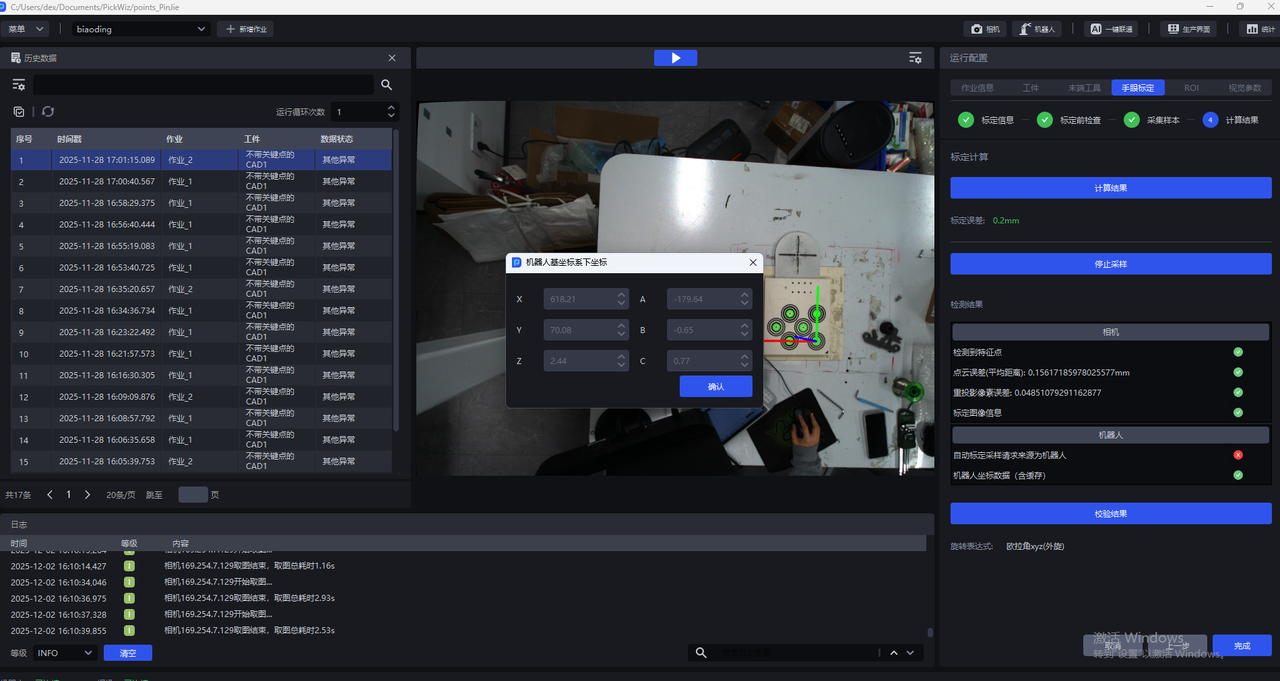
Calibration Image Information: eye-hand calibration image
Robot detection:
4.2 Calculate Calibration Results
Click Calculate Result. PickWiz calculates the calibration result based on the collected samples. If the calibration error does not meet the requirements, perform Calibration Result Inspection and Analysis.
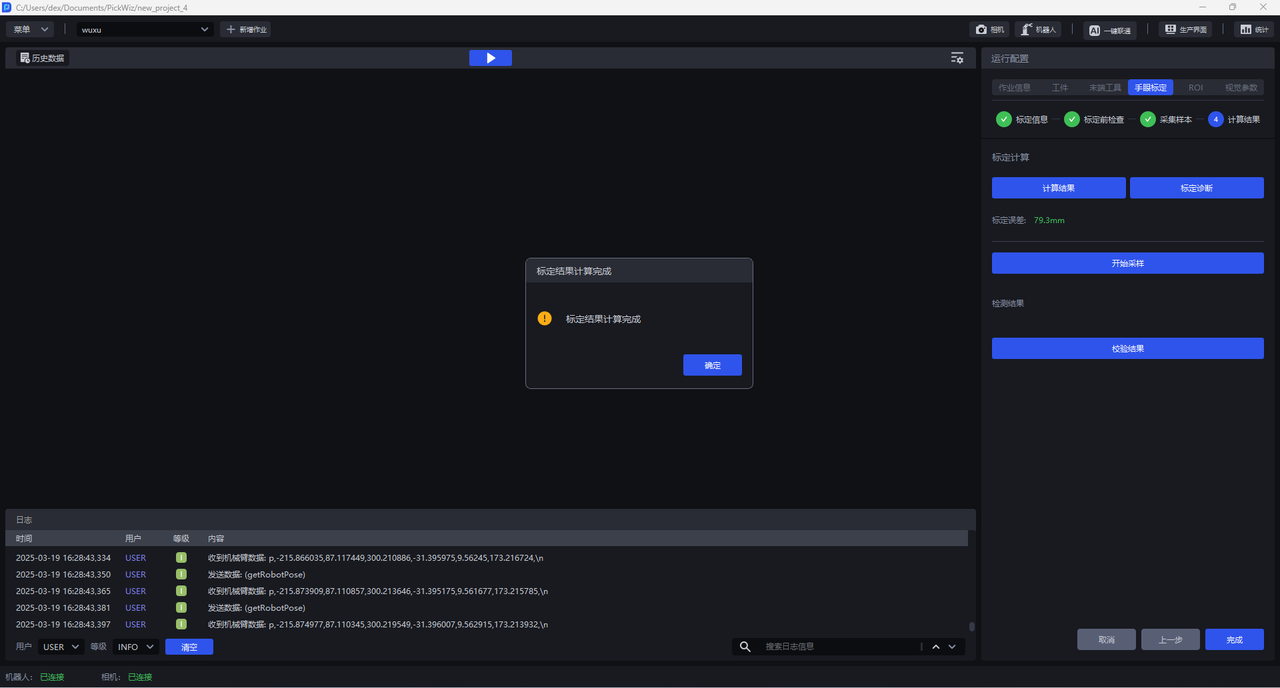
5. Calibration Result Inspection and Analysis
If the Calibration Error exceeds the normal range, the cause of the error must be identified. Click Calibration Diagnosis, then refer to Calibration Result Inspection and Analysis to analyze the calibration result, resolve the issue, and check again until the calibration accuracy meets the application requirements.
6. Select the Eye-Hand Calibration Configuration
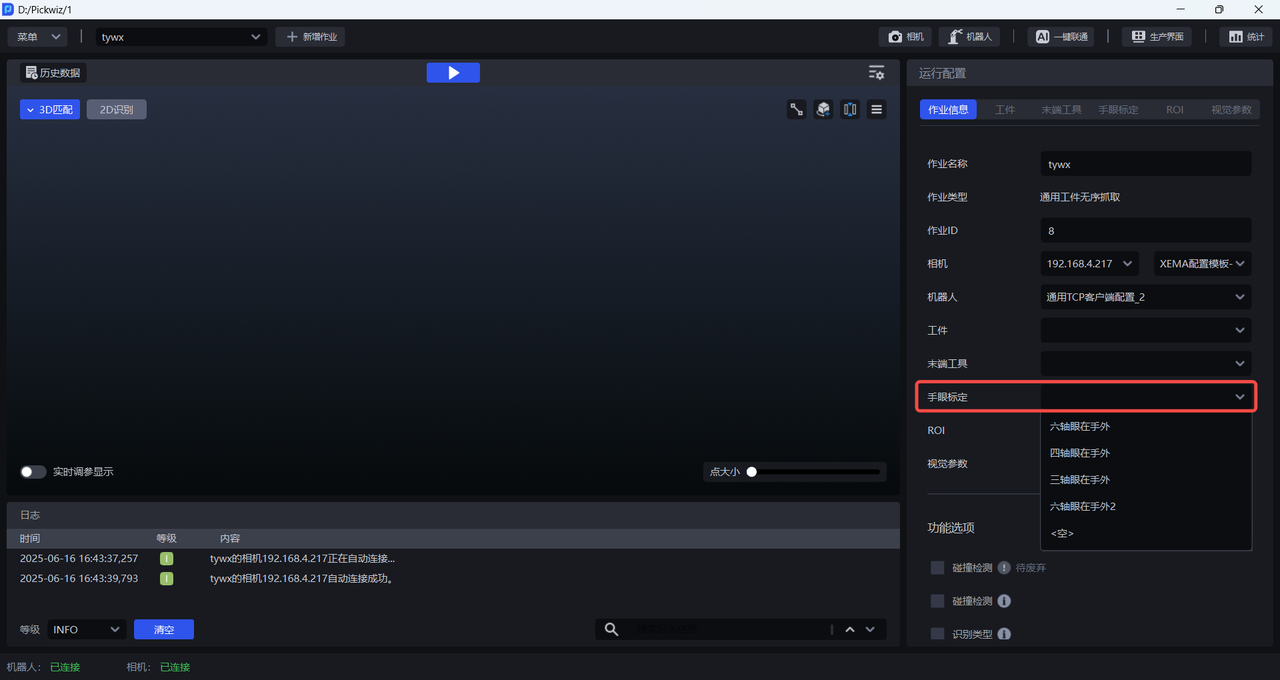
After the calibration workflow is completed, return to the Run Configuration interface, click Job Information, click the dropdown list for Eye-Hand Calibration, and select the corresponding eye-hand calibration configuration.