
Common Scenes and Solutions for Cycle Time Abnormalities
1. System configuration
(1) Mode selection: Debug mode -> Speed mode
- Reduce the amount of historical data saved
(2) Shadow mode: On -> Off
- Save shadow mode data
- When there are many instances, mask serialization is also very time-consuming.
(3) Memory mode: On ->Off
- Turning on the memory mode needs to be compared with the previous result. The more instances there are, the more time-consuming it will be.
(4) Number of pose calculations: The greater the number of calculations, the more time-consuming it is
(5) Picking logic:
- One capture, one pick: recalculate each time.
- One capture, multiple picks: calculate once and cache the result; retrieve subsequent results directly from the cache.
(6) Instance Point Cloud generation timing:
- After splitting: full instance calculation
- After filtering: Calculation after filtering out some instances (may affect global sorting)
(7) Grasping strategy
- Dynamic adjustment mechanism: Selecting a Target pose-related strategy moves sorting later in the workflow. The system calculates the poses of all instances before sorting, which takes much longer unless vision computation acceleration mode is enabled.
2. 2D recognition
(1) CAD-based synthetic data training (one-click connection)
| Scene | Expected Cycle time | Exception handling | Remarks | |
|---|---|---|---|---|
| Depalletizing (cartons/sacks) | 0-2000 ms | There are many instances (more than 50), and the Cycle time is greater than 2s Uncheck whether to return the mask 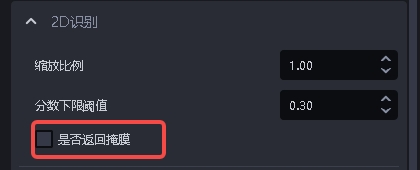 | / | |
| Universal Target (ordered/unordered/positioned assembly) | Axis-aligned bounding box | 0-2000 ms | / | |
| Oriented bounding box | 0-3500 ms | Using the trt model can reduce the Cycle time to 0 - 2000 ms | ||
| surface type Target (ordered/unordered/positioned assembly) | 0-2000 ms | / | ||
| Circle/Cylinder/Quadrilateral | 0-2000 ms | / | ||
Note: The automatic enhancement cycle time is superimposed according to the scaling ratio and the number of rotation angles. For example, with 2 scaling ratios and 2 rotation angles, the cycle time is expected to be 2*2=4 times the normal cycle time.
| Scaling ratio | Rotation angle | Expected Cycle time |
|---|---|---|
| [1.0] | [0, 90] | 2x normal Cycle time |
| [0.5, 0.8, 1.0] | [0, 90] | 6x normal Cycle time |
(2) Point Cloud segmentation
Instance Segmentation3D
| Scene | Expected Cycle time | Exception handling | Remarks |
|---|---|---|---|
| surface type Target is in order (materials are isolated from each other) | 0-3000 ms | ScenePoint Cloud is too large, appropriately increase the downsampling point spacing, and simultaneously increase the Point Cloud search radius 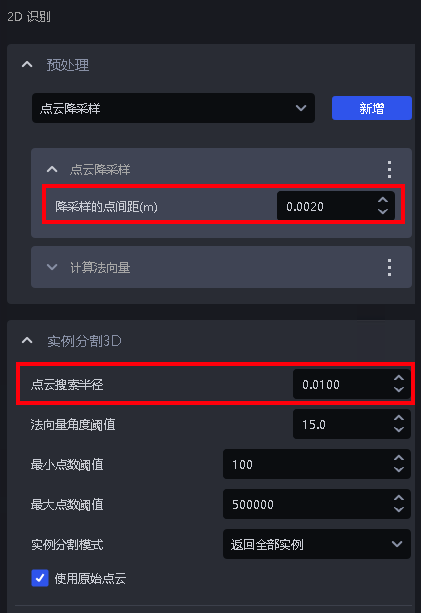 | Point The larger the number of Clouds, the longer the Cycle time, the more instances there are, and the longer the Cycle time. |
3. 3D matching
| type | Expected Cycle time | Exception handling | Remarks | |
|---|---|---|---|---|
| Rigid body transformation | 0-500 ms | No | uses dual model Cycle time will be in 0-1000ms | |
| Mask-based Pick Point generation | 50-1000 ms | No | Selecting your own vertical coordinate system for depalletizing sacks will increase the time by about 200ms | |
| basic geometry fitting | 0-500ms | No | / | |
| 3D registration icp’s Cycle time | Coarse Matching | 0-500ms | downsamplingParameter | / |
| Fine matching | 0-2000ms | Point Clouddownsampling(TargetPoint Cloud) | / | |
4. Functional plug-ins
| type | Expected Cycle time | Exception handling | Remarks |
|---|---|---|---|
| Pallet Detection | 50-1000 | No | / |
| Collision detection | Material frame detection: 0-500 ms Collision detection: 0-300 ms | No | / |
| Visual classification | 0-500 ms | No | / |
5. Commonly used functions
(1) 2D preprocessing
| type | Expected Cycle time | Exception handling | Remarks |
|---|---|---|---|
| edge enhancement | 20-200 | Cycle time is slow. You can close other redundant programs in the task manager to provide more computing resources for edge enhancement. | filters the points where the normal vector is greater than the angle Threshold and uses multi-threaded parallel calculation. Too many other running programs occupy a large amount of CPU computing resources, causing lags. |
| Extract upper texture | 0-800ms | Reduce the number of clustering Point Clouds | 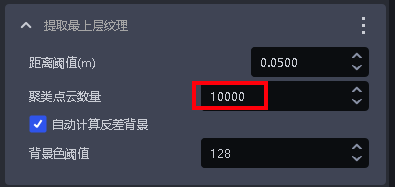 |
| Remove the picture background outside of roi3d | 0-300 | No | / |
(2) Point Cloud generation
| Type | Expected Cycle time | Exception handling | Remarks |
|---|---|---|---|
| By mask | 0-500 | None | 10 instances running about 130ms |
| By bounding box | 0-300 | None | 6 instances running 30ms |
| Remove image background outside of roi3d | 0-300 | None | / |
(3) 3D preprocessing
| type | Expected Cycle time | Exception handling | Remarks |
|---|---|---|---|
| Point Clouddownsampling | 0-200 ms | No | Point Cloud quantity is within 200,000 |
| Point Cloud removes outliers | 0-500 ms | No | Point Cloud quantity is within 200,000 |
| Point Cloud Plane Split | 0-200 ms | No | Point Cloud quantity is within 200,000 |
| calculation normal vector | 0-200 ms | No | Point Cloud quantity is within 200,000 |
| Filter out Point Cloud where the object distance exceeds the limit | 0-300 ms | No | / |
| Point Cloud clustering downsampling | 0-300ms | Add [Point Clouddownsampling (TargetPoint Cloud)] before the function | >=1.7.2 |
| Point Cloud contour extraction | 0-300ms | No | / |
| Remove points whose normals are greater than the angle Threshold | 20-200ms | No | / |
(4)Pick Point filtering
| type | Expected Cycle time | Exception handling | Remarks |
|---|---|---|---|
| Collision detection for fixture grabbing | 0 - 500 ms | No | is related to the number of patches input to the fixture. The greater the number of patches, the longer the Cycle time. The number of patches is limited to 500. |
| Determine the upper layer of Pick Point is blocked | 5-30 | No | / |
(5)Pick Point adjustment
| type | Expected Cycle time | Exception handling | Remarks |
|---|---|---|---|
| Attitude adjustment based on axis rotation | 0-2000ms | Reduce the rotation angle range (symmetrical angle) Create a separate template with many Point Cloud features and a small quantity, pass the template Point Cloud path into the function, or use edges for optimization Select Fast in evaluation mode for acceleration. Warning: if the Initial Pose is inaccurate or the Pick Point is not at the center of symmetry, the effect will be affected 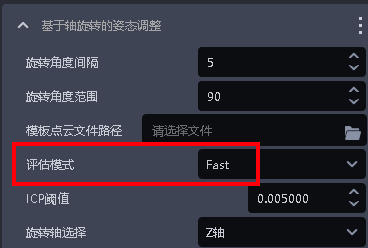 | Point The larger the Cloud template is, the longer it takes 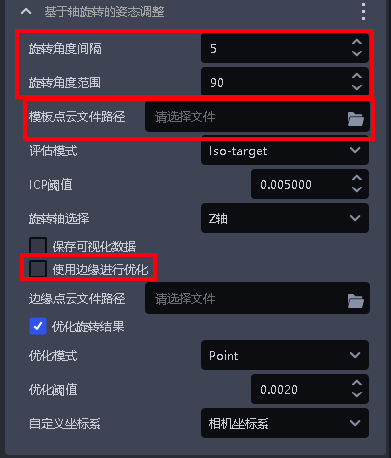 |
| Refined attitude function based on plane discovery | 0 - 200 ms | No | / |
| Symmetric center posture optimization | 0-1000ms | Reduce the search range Increase the image scale In mirror mode, reduce the rotation angle (10–30) If lower accuracy is acceptable, reduce the projection resolution | Version 1.7.1 has abnormal GPU memory usage and processing time in rotation mode. If the Target meets the conditions for mirror symmetry, use mirror-symmetry mode. Otherwise, contact the product and R&D teams for a custom solution or upgrade to 1.7.2.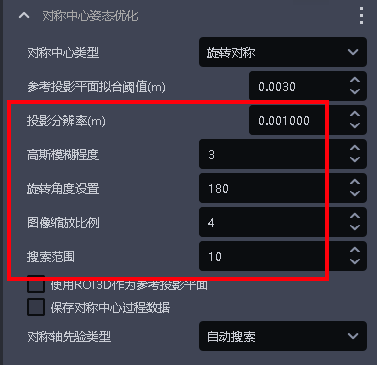 |
| calculation normal vector | 0-200 ms | No | Point Cloud quantity is within 200,000 |
| Filter out Point Cloud where the object distance exceeds the limit | 0-300 ms | No | / |
| Point Cloud clustering downsampling | 0-300ms | Add [Point Clouddownsampling (TargetPoint Cloud)] before the function | >=1.7.2 |
| Point Cloud contour extraction | 0-300ms | No | / |
| Remove points whose normals are greater than the angle Threshold | 20-200ms | No | / |
(6) Instance sorting
- XYZ, roi distance, robot arm distance and other strategies that need to extract Point Cloud
- The expected time consumption of a single Target is: 0.003s-0.03s. The more TargetPoint Clouds, the more time it takes.