Task Operation Guide
A task in PickWiz refers to a set of related operations executed by a Robot in a specific industrial scene, including depalletizing, random picking, ordered loading and unloading, positioning assembly, and so on.
In PickWiz, a task is a software work unit smaller than a Project and contains multiple task-related configurations, including workpieces, Tool, eye-hand calibration, ROI (Region of Interest), vision Parameters, Camera, Robot, and so on.
1. Create a New Task
1.1 Create the First Task
When creating a new Project, you need to select a task scene. After the Project is created, PickWiz by default provides the first task. Please refer to Project Operation Guide to create a new Project.
A new Project comes with one task by default
1.2 Create Multiple Tasks
In some industrial scenes, multiple material areas may exist, such as in component assembly. In this case, one Robot may need to pick multiple kinds of materials at the same time, or move between multiple material areas, and may also need to complete different task types such as depalletizing, ordered loading and unloading, and random picking.
To meet this requirement, in PickWiz, you can create multiple tasks within the same Project according to different working conditions and then perform subsequent task configurations. In this way, the Robot can carry out multiple task operations simultaneously, greatly improving industrial production efficiency.
Click + New Task, and the interface will automatically jump to the new task page.
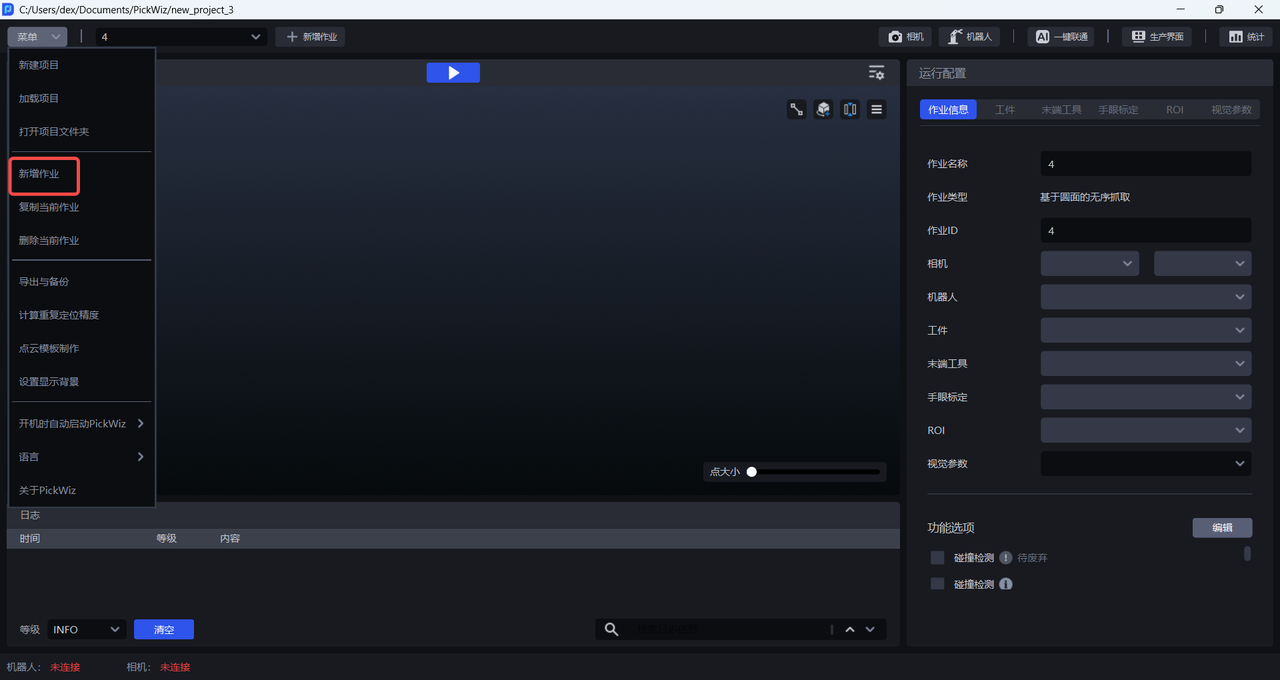
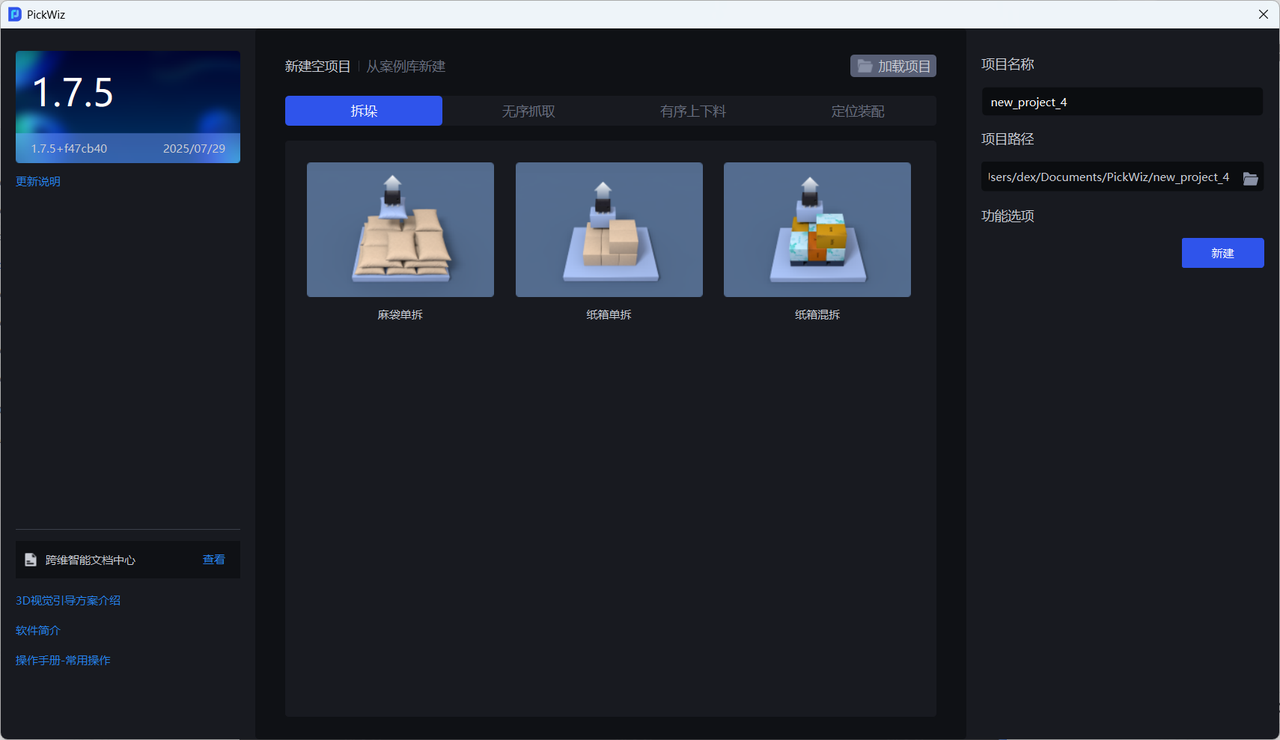
According to actual needs, select the corresponding task scene, enter the task name, and finally click Create to create a new task.
Please refer to Introduction to 3D Vision Guidance Solutions to select the required task scene.
2. Configure the Task
Before running a task, you need to select all configuration items in the task information.
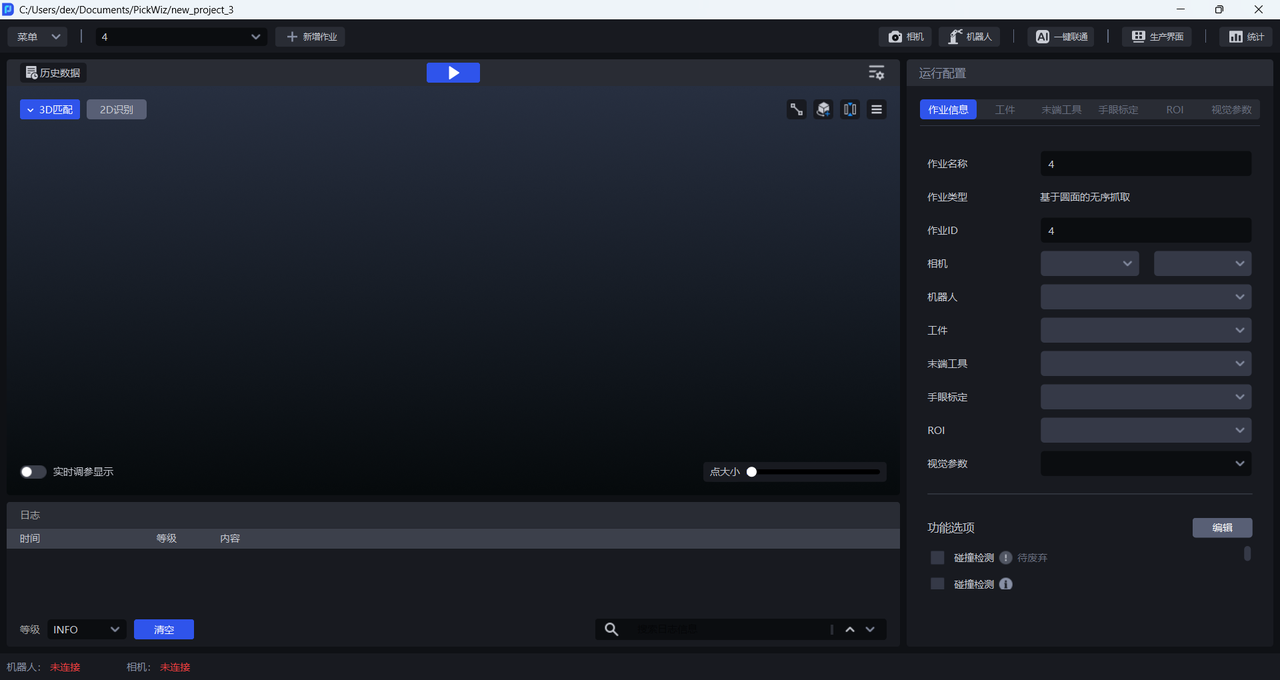
| Configuration Item | Description |
|---|---|
| Task Name | The name of the current task, editable |
| Task Type | The type of the current task, that is, the task scene, corresponding to the task scene selected when creating a new task, and cannot be modified |
| Task ID | Identifies the current task. The Robot can switch tasks through this ID |
| Camera | The Camera and Camera Parameters used when the current task runs. For connecting the Camera and adjusting camera imaging, refer to Camera Connection and Parameter Adjustment Guide |
| Robot | The Robot used when the current task runs. For establishing communication with the Robot, refer to Robot Configuration and Communication Operation Guide |
| Workpiece | The workpiece configuration of the current task. Configure it in the task information after adding it in the workpiece interface. To add a new workpiece, refer to Workpiece Operation Guide |
| Tool | The Tool configuration used when the current task runs. Configure it in the task information after adding it in the Tool interface. To add a new Tool, refer to Tool Usage Guide |
| Scene Object | Various objects in the current task scene, including containers, bottom supports, and so on. The Scene Object interface appears only after selecting Collision Detection, Bottom Support Detection, and Separator and Bottom Support Detection in Function Options. After adding a new Scene Object, it needs to be configured in the task information. For the specific process, refer to Bottom Support Detection Guide、 Collision Detection Guide、 Separator and Bottom Support Detection Guide |
| eye-hand calibration | The eye-hand calibration configuration used when the current task runs. Configure it in the task information after adding it in the eye-hand calibration interface. For the specific process, refer to eye-hand calibration Operation Guide |
| ROI | The ROI configuration used when the current task runs. Configure it in the task information after adding it in the ROI interface. For the specific process, refer to ROI Operation Guide |
| Vision Parameters | The vision Parameter configuration used when the current task runs. Configure it in the vision Parameter interface. For the specific process, refer to the Vision Parameter Adjustment Guide |
After selecting all configuration items, click  Button to run the current task.
3. Delete a Task
(1)Delete any task: click the task drop-down box to view all tasks, move the mouse cursor over the task to be deleted, and the 🗑 function Button will appear; click 🗑 to delete the task and its configuration.
(2)Delete the current task: open the menu and click delete current task to delete the current task and its configuration.
4. Copy a Task
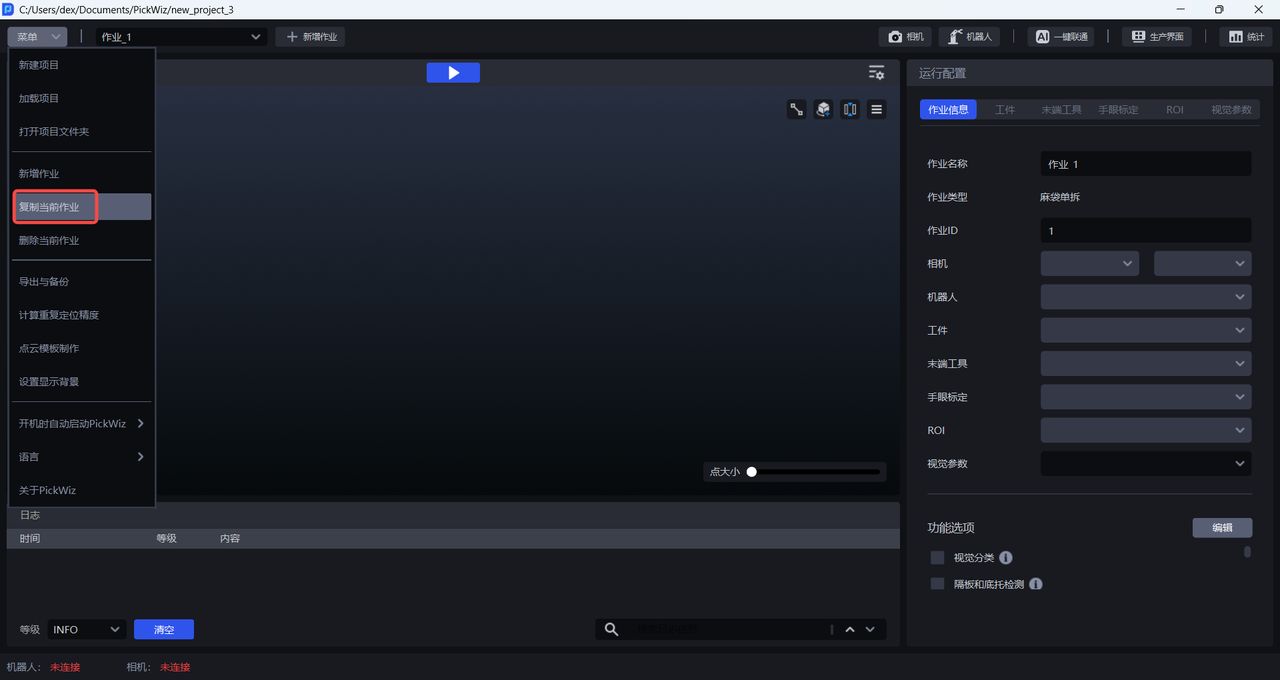
Open the menu and click Duplicate Current Task to get a new copy of the task. This task copy duplicates all configurations of the original task.
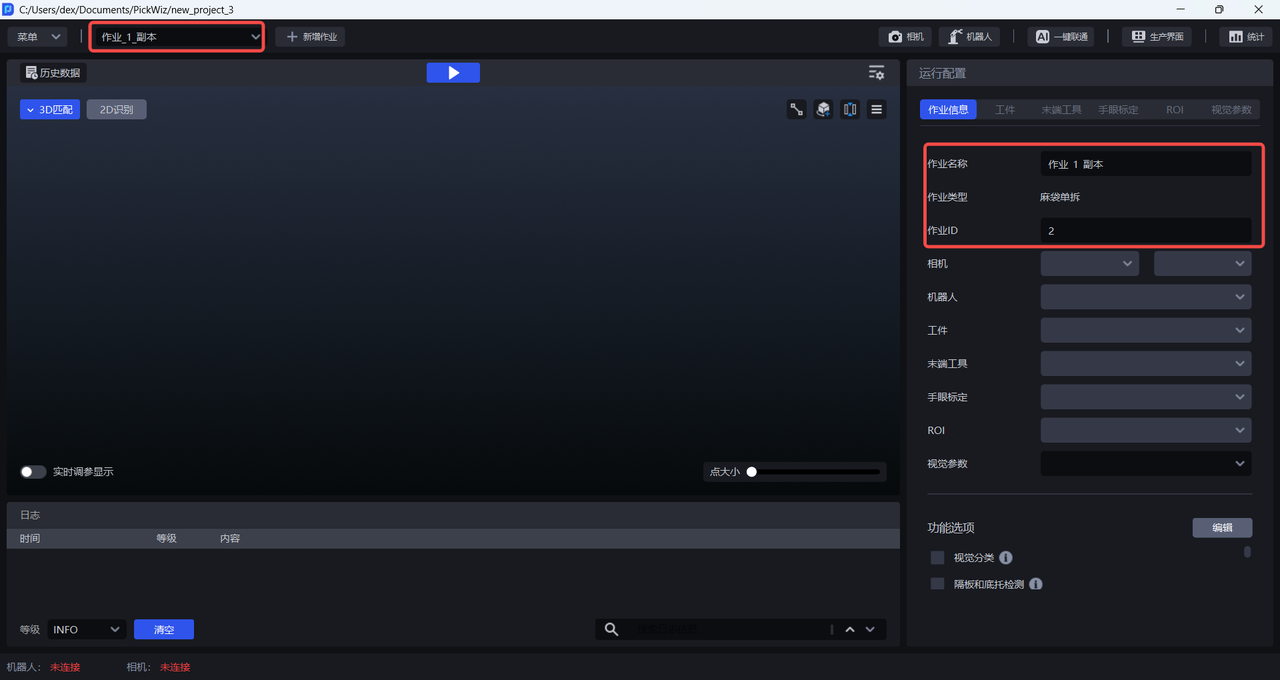
5. Switch Tasks
During task execution, there are two ways to switch tasks: switching on the PickWiz software side and switching on the Robot side.
5.1 PickWiz Switching
You can click the task drop-down box at the upper left corner of the main interface to select the task that currently needs to run.
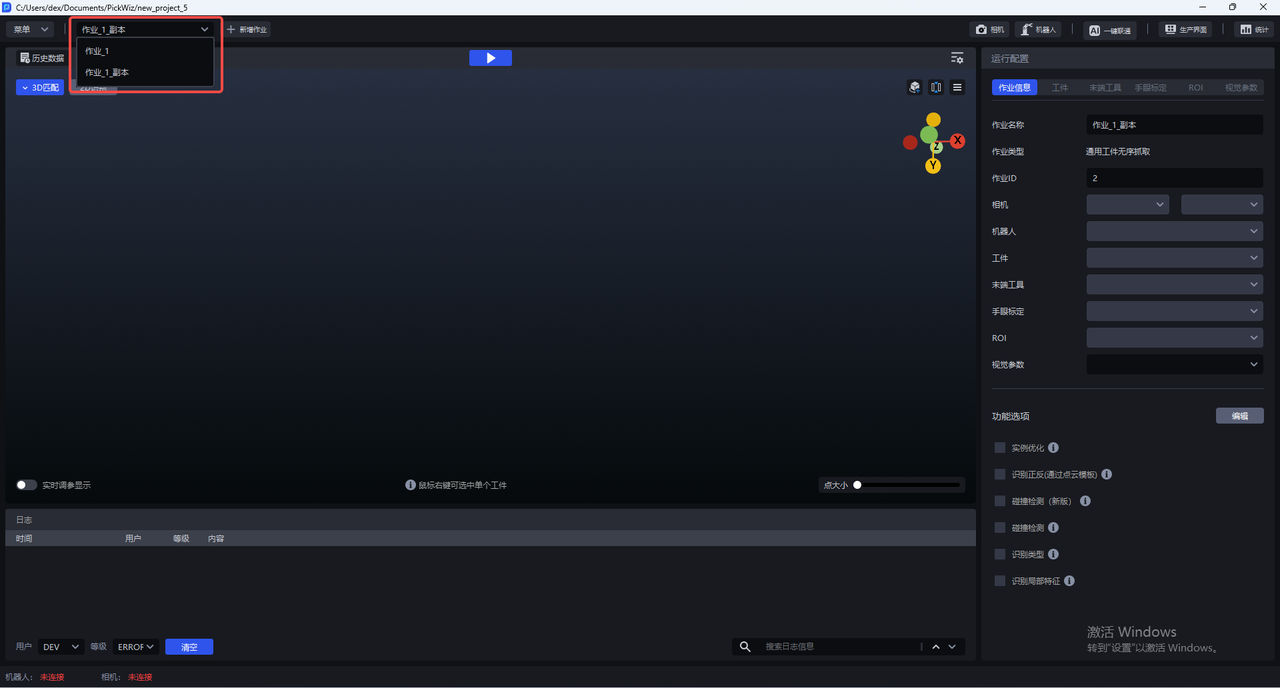
5.2 Robot Switching
You can import an engineering file with business logic on the Robot side so that the Robot sends a signal to PickWiz to switch tasks. The Robot can communicate with PickWiz through the command content {wid} (task ID) and complete task switching.
For the communication method and commands between PickWiz and the Robot, please refer to Robot Configuration and Communication Operation Guide